

Father and Son
The Odyssey Book 16

Exploring Life through the Written Word
"Now don't imagine I am a god—why take me for a god? / No, I am your father, the Odysseus you wept for, / you suffered years of pain, the cruel abuse of men."
Dear friends,
Book 16 of Homer's The Odyssey is one of the most emotional chapters in all of ancient literature. This extraordinary book orchestrates the long-awaited reunion between Odysseus and Telemachus while simultaneously advancing the plot toward its climactic resolution. The chapter operates on multiple levels of meaning, functioning as both an intimate family drama and a strategic planning session for the restoration of rightful authority in Ithaca. Through careful attention to psychological realism, divine intervention, and political necessity, Homer creates a narrative that speaks to universal themes of family, identity, and justice while maintaining the epic's mythic grandeur.
The significance of Book 16 extends far beyond its immediate emotional impact. The reunion between father and son represents the first step in the restoration of natural order that has been disrupted by the suitors' lawless behavior. Yet Homer avoids simple sentimentality by grounding the emotional reunion in practical considerations about strategy, timing, and the harsh realities of political power. The chapter demonstrates the poet's sophisticated understanding of how personal relationships intersect with larger social and political structures, creating a narrative that is simultaneously intimate and epic in scope.
Moreover, Book 16 serves as a crucial test of character for both protagonists. Odysseus must balance his paternal emotions with strategic necessity, while Telemachus faces the challenge of accepting his father's leadership after developing his own independence and authority. The chapter explores how family relationships can provide both emotional sustenance and practical strength while acknowledging the complex negotiations required when individuals who have grown apart must learn to work together toward common goals.
Recognition, Reunion, and Conspiracy
Book 16 opens with Telemachus's arrival at Eumaeus's hut, where he encounters the disguised Odysseus without recognizing his father. The dramatic irony of this situation—the audience knows what the characters do not—creates powerful tension while highlighting the theme of recognition that permeates the entire epic. Eumaeus's joy at his young master's safe return contrasts poignantly with Odysseus's internal struggle to maintain his disguise while seeing his son for the first time in twenty years.
The initial interaction between father and son, conducted while Odysseus remains disguised as a beggar, provides crucial character development for both figures. Telemachus demonstrates the courtesy and generosity appropriate to his station, treating the apparent stranger with respect while showing concern for his welfare. His questions about the beggar's origins and his offer of hospitality reveal the same values that characterize his father, suggesting that Odysseus's influence has shaped his son's character despite their long separation.
Meanwhile, Odysseus observes his son carefully, assessing both his physical development and his moral character. The prince's respectful treatment of a seemingly lowly stranger confirms that he possesses the qualities necessary for effective leadership. His diplomatic handling of the situation—showing kindness without compromising his authority—demonstrates the mature judgment that will prove essential in the challenges ahead.
The dramatic revelation comes when Eumaeus leaves the hut to inform Penelope of her son's safe return. Alone with Telemachus, Odysseus receives divine assistance from Athena, who removes his disguise and restores his natural appearance. The transformation scene showcases Homer's understanding of the supernatural while maintaining psychological credibility. Athena's intervention serves not merely as magical spectacle but as divine confirmation of Odysseus's identity and the righteousness of his cause.
Telemachus's reaction to his father's revelation provides one of the epic's most psychologically complex moments. Initially, he refuses to believe that the beggar could be his father, suspecting divine deception or supernatural trickery. His skepticism reflects both rational caution and the profound psychological difficulty of accepting such an extraordinary transformation. The prince's demand for proof demonstrates the mature judgment that has characterized his development throughout the epic, while his emotional struggle reveals the deep impact of their long separation.
Odysseus's response to his son's doubt showcases both his understanding of human psychology and his skill at persuasion. Rather than becoming angry at Telemachus's skepticism, he patiently explains the divine assistance that has enabled his survival and return. His account of Athena's protection provides context for understanding how mortal excellence and divine favor can work together to achieve seemingly impossible outcomes.
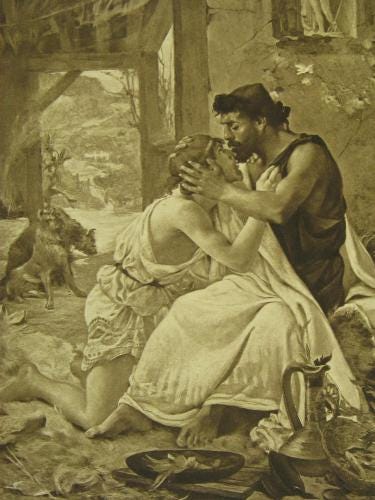
The recognition scene that follows ranks among the most emotionally powerful passages in ancient literature. Homer describes the moment when father and son finally embrace with remarkable restraint and dignity, avoiding excessive sentimentality while conveying the profound emotional significance of their reunion. The poet's comparison of their weeping to the cries of birds whose young have been stolen emphasizes both the natural bond between parent and child and the years of separation that have kept them apart.
However, Homer immediately balances emotional catharsis with practical necessity. After their initial reunion, Odysseus quickly turns the conversation toward strategic planning, recognizing that sentiment alone cannot resolve the crisis facing their family and kingdom. His transition from emotional father to strategic leader demonstrates the complex demands placed on individuals who must operate simultaneously in personal and political spheres.
The plotting session that occupies much of the chapter's remainder showcases both men's tactical intelligence while revealing the magnitude of their challenge. Odysseus methodically gathers information about the suitors' numbers, resources, and behavior patterns, while Telemachus provides detailed intelligence about the palace's current state. Their discussion reveals the suitors to be numerous, well-armed, and supported by allies from neighboring islands—a formidable opposition that cannot be confronted through simple force.
Odysseus's strategic thinking demonstrates the qualities that enabled his survival during twenty years of wandering. He recognizes that success will require careful timing, divine assistance, and the support of loyal followers rather than heroic individual action. His plan to return to the palace in disguise while Telemachus assumes his normal role shows sophisticated understanding of how to gather intelligence while positioning resources for maximum effectiveness.
The chapter also reveals important information about the political situation in Ithaca through the characters' discussion of potential allies and enemies. The loyal servants who might support Odysseus's return are outnumbered by those whose loyalty remains uncertain. This realistic assessment of political relationships adds complexity to the narrative while emphasizing that restoration of legitimate authority requires more than simply revealing Odysseus's identity.
Telemachus's response to his father's strategic planning reveals his continued maturation as a leader. Rather than simply deferring to parental authority, he asks thoughtful questions and offers valuable insights based on his recent experiences. His suggestion about how to handle various household members demonstrates practical wisdom, while his acceptance of a subordinate role in the coming confrontation shows appropriate humility without sacrificing personal dignity.
The chapter concludes with careful attention to maintaining their deception. Athena restores Odysseus's beggar disguise, and father and son agree on the story they will tell about the stranger's identity. Their ability to coordinate their deception while managing their emotions demonstrates the self-control and strategic thinking that will prove essential to their success.
Meanwhile, the narrative briefly shifts to the suitors, who discover that their ambush of Telemachus has failed. Their reaction to this failure reveals both their continued arrogance and their growing desperation. The debate among them about whether to attempt another assassination shows the moral degradation that has resulted from their lawless behavior, while their decision to continue their destructive presence in the palace sets up the confrontation to come.

Literary Analysis
Recognition and Identity
Book 16's recognition scene represents the culmination of one of the epic's central themes—the complex relationship between appearance and identity. Throughout The Odyssey, characters struggle to recognize others whose identities have been concealed by divine intervention, physical transformation, or the simple passage of time. The reunion between Odysseus and Telemachus provides the most emotionally significant example of this theme while exploring the psychological challenges inherent in such recognition.
Homer's handling of the recognition process demonstrates sophisticated understanding of human psychology. Telemachus's initial disbelief reflects not only rational skepticism but also the psychological defense mechanisms that protect individuals from the disappointment that might result from false hope. His demand for proof and his careful questioning show how recognition requires not just physical evidence but emotional and intellectual acceptance of radically changed circumstances.
The divine element in Odysseus's transformation serves multiple narrative functions. On the literal level, Athena's intervention explains how a man aged by twenty years of hardship can appear as his son remembers him. More significantly, the divine transformation provides cosmic validation of Odysseus's identity and mission, suggesting that his return represents the restoration of natural order rather than merely personal vengeance.
The recognition scene also explores the relationship between knowledge and emotional truth. While Telemachus gradually accepts the intellectual evidence of his father's identity, the emotional reality of their reunion requires time to process. Homer's description of their extended weeping acknowledges that profound emotional experiences cannot be rushed or easily controlled, even when they represent the fulfillment of long-held desires.
Family Dynamics and Authority
The interaction between Odysseus and Telemachus throughout Book 16 reveals Homer's nuanced understanding of family relationships and the complexities of parental authority. The twenty-year separation has allowed Telemachus to develop into an independent young man with his own judgment and leadership capabilities. Odysseus must therefore navigate the delicate process of reestablishing paternal authority without undermining his son's newfound confidence and competence.
The chapter demonstrates how effective family relationships require mutual respect and recognition of individual capabilities. Odysseus does not simply assume that Telemachus will defer to his authority; instead, he explains his reasoning, seeks his son's input, and acknowledges the valuable knowledge the prince has gained during his absence. This collaborative approach to family leadership provides a model that transcends historical periods and cultural boundaries.
Telemachus's response to his father's return reveals his own maturity and wisdom. Rather than either complete submission or rebellious assertion of independence, he strikes a balance that honors both his father's experience and his own development. His willingness to accept a subordinate role in the coming confrontation demonstrates strategic thinking rather than weakness, while his continued questions and suggestions show that he has not abandoned his own judgment.
The family dynamics portrayed in Book 16 also reflect broader themes about the restoration of social order. The reunion between father and son represents the first step toward reestablishing legitimate authority in Ithaca. Their ability to work together effectively provides hope that the larger social disruptions caused by the suitors can also be resolved through the restoration of proper relationships and mutual respect.
Strategic Planning and Political Realism
Homer's portrayal of Odysseus and Telemachus's strategic planning reveals sophisticated understanding of political and military realities. The chapter avoids both naive optimism about heroic individual action and cynical pessimism about the possibility of justice. Instead, it presents a realistic assessment of the challenges they face while demonstrating how careful planning, divine favor, and moral legitimacy can combine to overcome seemingly impossible odds.
The detailed discussion of the suitors' numbers and resources shows Homer's attention to practical military considerations. Odysseus recognizes that success will require more than personal courage; it will demand careful intelligence-gathering, strategic timing, and the ability to maximize available resources while minimizing risks. His plan to maintain his disguise while positioning himself within the palace demonstrates the kind of strategic thinking necessary for effective leadership in dangerous circumstances.
The chapter also explores the political dimensions of their situation. The suitors represent not just personal enemies but a challenge to the entire social order of Ithaca. Their behavior violates fundamental customs regarding hospitality, respect for authority, and proper conduct toward women and children. Odysseus's return therefore represents not merely personal revenge but the restoration of legitimate government and social stability.
The realistic assessment of potential allies and enemies adds complexity to the narrative while showing how political success depends on understanding and managing networks of relationships. The uncertain loyalty of various household members reflects the practical challenges facing any leader attempting to restore authority after an extended absence during which alternative power structures have developed.
Divine Intervention and Human Agency
Book 16 continues the epic's sophisticated exploration of the relationship between divine assistance and human effort. Athena's intervention in revealing Odysseus's identity to Telemachus serves crucial narrative functions while maintaining the balance between supernatural elements and psychological realism that characterizes the entire work.
The goddess's assistance operates within recognizable bounds, enhancing rather than replacing human capabilities. Her removal of Odysseus's disguise allows father and son to recognize each other, but their emotional reunion and strategic planning depend entirely on their own wisdom and affection. The divine element validates their mission without diminishing their personal responsibility for its execution.
Homer's treatment of divine intervention also reflects ancient Greek theological concepts about the relationship between mortals and immortals. The gods support those who demonstrate excellence and virtue, but this support requires active human participation rather than passive dependence. Odysseus's long survival and eventual return result from the combination of divine favor with his own cunning, endurance, and moral integrity.
The prophetic elements introduced through Theoclymenus in the previous chapter continue to influence events in Book 16, creating a sense of fate unfolding through natural means. The convergence of circumstances that enables the reunion—Telemachus's divinely guided return, Odysseus's presence at Eumaeus's hut, the seer's prophetic insights—suggests cosmic orchestration while maintaining plausible causation.
Social Class and Loyalty
Book 16 continues the epic's complex exploration of the relationship between social status and moral worth through its portrayal of various characters' responses to the developing crisis. Eumaeus's unwavering loyalty to his absent master contrasts sharply with the disloyalty of other servants who have been corrupted by the suitors' influence. His joy at Telemachus's safe return and his protective concern for both family members demonstrate how genuine loyalty transcends mere duty to become personal devotion.
The chapter's discussion of potential allies among the palace staff reveals the complex social dynamics that have developed during Odysseus's absence. Some servants remain loyal to their legitimate masters, others have been intimidated or corrupted by the suitors, and still others occupy uncertain middle positions that make their ultimate allegiance unpredictable. This realistic portrayal of how extended political crisis affects social relationships adds depth to the narrative while showing how the restoration of legitimate authority requires attention to multiple levels of social organization.
The contrast between loyal servants like Eumaeus and the disloyal suitors reinforces themes about the nature of true nobility. While the suitors possess aristocratic birth and wealth, their behavior reveals fundamental moral corruption. The humble swineherd, despite his servile status, demonstrates wisdom, integrity, and courage that surpass those of his social superiors. This inversion of conventional hierarchies serves both as social commentary and as preparation for the justice that will ultimately be administered based on moral rather than social criteria.
Historical and Cultural Context
Book 16 provides valuable insights into various aspects of ancient Greek society, from family structures and political organization to military tactics and religious beliefs. The detailed portrayal of the relationship between Odysseus and Telemachus reflects actual practices regarding inheritance, authority, and the transition of leadership from one generation to the next in aristocratic households.
The chapter's attention to strategic planning and military assessment reflects the realities of warfare in the ancient Mediterranean world. The discussion of weapons storage, ally networks, and tactical approaches shows understanding of how small groups could successfully challenge larger forces through superior planning and local knowledge. The emphasis on intelligence-gathering and careful timing reflects military wisdom that transcends historical periods.
The religious elements in the chapter—divine transformations, prophetic insights, ritualized recognition—correspond to documented ancient Greek beliefs about divine intervention in human affairs. The portrayal of gods as active participants in human events while respecting human free will reflects theological concepts that influenced classical culture for centuries.
The social dynamics portrayed in the chapter also illuminate the structure of ancient Greek households and the complex relationships between masters, servants, and dependents that characterized palatial economies. The various levels of loyalty and service represented by different characters provide insights into how these hierarchical societies functioned during periods of political stability and crisis.
Contemporary Relevance
The themes explored in Book 16 maintain remarkable relevance for contemporary readers facing similar challenges in different contexts. The reunion between Odysseus and Telemachus speaks to universal experiences of family separation and reunion, whether caused by military deployment, economic necessity, imprisonment, or other circumstances that divide families over extended periods. The psychological challenges they face—rebuilding trust, negotiating authority, integrating changed identities—resonate across cultural and temporal boundaries.
The strategic planning sequences offer insights relevant to anyone facing the challenge of confronting entrenched opposition with limited resources. Odysseus's careful assessment of enemies and allies, his attention to timing and positioning, and his realistic evaluation of available options provide models for strategic thinking that apply to business, political, and personal contexts. The chapter's emphasis on gathering intelligence before taking action remains relevant for contemporary decision-making in complex situations.
The family dynamics portrayed in the chapter provide insights into how relationships can be maintained and rebuilt across generational and experiential divides. The mutual respect between father and son, their collaborative approach to problem-solving, and their ability to balance emotional connection with practical necessity offer models for contemporary family relationships facing similar challenges.
The theme of legitimate authority confronting corrupt opposition resonates in contemporary political contexts where established institutions face challenges from those who reject traditional norms and constraints. The chapter's exploration of how legitimate leadership can be restored through the combination of moral authority, strategic planning, and popular support provides insights relevant to various contemporary situations involving institutional reform and political restoration.
Perhaps most significantly, Book 16's portrayal of how individual relationships intersect with larger social and political structures speaks to contemporary concerns about the role of personal integrity in public life. The chapter demonstrates how family loyalty, personal courage, and moral conviction can serve as foundations for broader social change while acknowledging the practical challenges inherent in translating personal virtues into effective public action.
Conclusion
Book 16 of The Odyssey represents one of ancient literature's most successful integrations of emotional depth with strategic complexity. The reunion between Odysseus and Telemachus provides profound emotional satisfaction while advancing the plot toward its climactic resolution. Homer's ability to balance sentiment with practical necessity creates a narrative that speaks to both the heart and the mind, demonstrating how personal relationships can provide both emotional sustenance and practical strength in confronting seemingly impossible challenges.
The chapter's sophisticated character development reveals both protagonists at their most admirable. Odysseus demonstrates the wisdom and self-control that have enabled his survival while showing the paternal love that has motivated his long journey home. Telemachus displays the maturity and judgment that mark his successful transition to adulthood while maintaining the respect for authority and tradition that will enable effective collaboration with his father. Their relationship provides a model of how individuals can maintain both independence and mutual loyalty while working toward common goals.
The strategic planning that occupies much of the chapter demonstrates Homer's understanding that heroic ideals must be tempered by practical wisdom. The careful attention to intelligence-gathering, resource assessment, and tactical coordination shows how effective action requires more than courage and moral certainty. The chapter's realistic portrayal of the challenges facing Odysseus and Telemachus creates suspense about the outcome while establishing the foundation for their ultimate success.
Book 16 also serves crucial structural functions within the larger epic, providing the emotional and strategic foundation necessary for the dramatic confrontations that follow. The reunion between father and son represents the first step in the restoration of natural order, while their joint planning session establishes the framework within which justice will ultimately be administered. The chapter's careful attention to both personal and political dimensions creates a narrative that satisfies on multiple levels while maintaining thematic coherence.
The enduring appeal of Book 16 lies in its successful combination of universal human experiences with specific cultural and historical contexts. The emotions explored—parental love, filial respect, the joy of reunion, the challenges of collaboration—transcend temporal and cultural boundaries while remaining grounded in recognizable ancient Greek social structures and religious beliefs. This combination creates a work that speaks to readers across centuries while maintaining its distinctive cultural identity.
As readers prepare for the epic's climactic books, Book 16 provides essential preparation by establishing both the emotional stakes and the practical framework that will determine the outcome. The chapter's demonstration that effective action requires the integration of feeling and thinking, personal loyalty and strategic wisdom, individual excellence and collaborative effort, offers insights that remain relevant for contemporary readers facing their own complex challenges.
Study Questions
Recognition and Family Relationships: The recognition scene between Odysseus and Telemachus is one of literature's most famous reunions, yet it's immediately followed by practical strategic planning. How does Homer balance emotional sentiment with practical necessity in this chapter? What does this suggest about how family relationships function during times of crisis? How might this ancient portrayal of father-son relationships offer insights for contemporary families dealing with separation, reunion, and the challenge of rebuilding relationships after extended absence?
Leadership and Authority: Both Odysseus and Telemachus have developed as leaders during their separation—Odysseus through his survival experiences and Telemachus through his journey to find his father. How do they negotiate the transition from Telemachus's independence back to a father-son collaboration? What does their interaction reveal about effective leadership and the relationship between experience and authority? How might their model of collaborative leadership apply to contemporary situations involving mentorship, succession planning, or family businesses?
Strategic Thinking vs. Heroic Action: Throughout their planning session, Odysseus emphasizes careful strategy, intelligence-gathering, and realistic assessment of their challenges rather than relying on traditional heroic individual action. What does this suggest about Homer's view of effective leadership and problem-solving? How does this approach compare to other heroic models in ancient literature? What relevance might this strategic approach have for contemporary individuals facing situations where they must confront entrenched opposition or institutional corruption with limited resources?

Reading Assignment for Next Week
We will cover Book 17. In the Fagles translation, this chapter is titled Stranger at the Gates and spans pages 354-374. In the Wilson translation, this chapter is titled Insults and Abuse and spans pages 386-407.
Beyond the Bookshelf is a reader-supported publication. If you've found value in my work and it has helped, informed, or entertained you, I'd be grateful if you'd consider leaving a tip. Your support helps me continue creating content and means more than you know. Even small contributions make a real difference and allow me to keep sharing my work with you. Thank you for reading and for any support you're able to offer.
Affiliate links: You can click on the title of any book mentioned in this article to purchase your own copy. These are affiliate links, earning me a very small commission for any purchase you make.
Until next time,

Previous articles in this series:
If you are a new subscriber or missed any of the previous articles in this series, you can catch up at the link below:

All opinions in this essay are my own unless otherwise noted. Additionally, I have highlighted all sources in the text if needed.

Thank you, Matthew!
So good 👍