

Commonplace #15
Some things that recently caught my interest

Navigating the passages between books and being
Dear friends,
Over the holidays I spent a lot of time alone. Too much in fact. Even for an introvert it was a bit much. Reminded me a bit of COVID without the face mask. My family traveled to Peru to visit my wife’s relatives for Christmas. I stayed home for a few reasons, primarily because I had medical appointments with the Veterans Administration. I spent a lot of time reading, thinking, writing, playing with the dog, taking long walks, staring into the fire, drinking coffee, and listening to jazz. Everyday. For 2.5 weeks.
It sounds like an introvert’s dream right? In truth it was painfully lonely. I missed my kids. I regretted not going with them. The dog isn’t the best conversationalist. I was committed to eating what food we had in the house to save a bit of money. This resulted in quite a few meals of ramen noodles, barely identifiable meat products I found buried in the freezer, and some odd combinations of random things I found in the pantry. Oh, did I mention that one of the best things about Peru is the cuisine? The culinary scene is amazing. But alas I was at home in Tennessee eating turkey hot dogs I found in the drawer of my fridge.
A blessing I experienced during this time was the opportunity to reflect on life, my priorities, how I spend my time and energy, and what I want for my future. Much of this is private and won’t be spelled out here. The big picture really boiled down to understanding and staying true to myself. It is easy to get caught up in comparing ourselves to others or trying to keep up with others. I found that was the case when writing Beyond the Bookshelf in 2025. I compared myself to many people with larger audiences, who were making more money, or who were better writers.
This impulse to be like someone else destroys the very nature of my being. It destroys my uniqueness. It devours the joy in my life. The things I love about myself lose their color and become part of the grayness of despair I feel in the never-ending competition loop of online social transactions. I could not continue like this and knew that something needed to change.
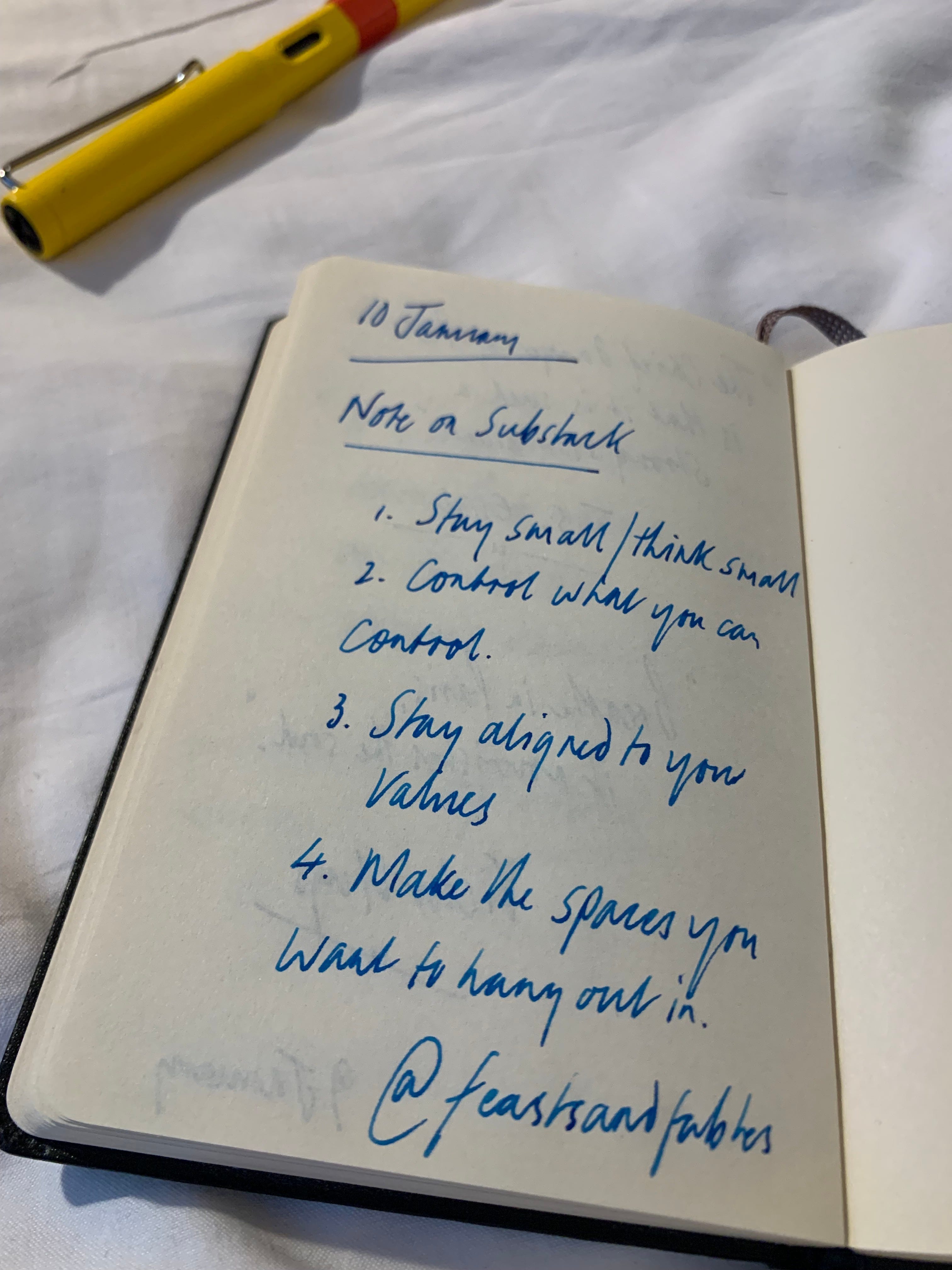
My dear friend Barrie, the co-author of Feasts and Fables shared a photo from his journal from January 2025. While Barrie was writing this for himself, his simple, personal call to action resonated with me as it captured all the things that were in my heart.
Stay small / think small. - During the first two years of Beyond the Bookshelf I became obsessed with growing a huge audience. I lost touch with what mattered most to me - the closeness of a small, committed community of friends. I am a deeply introverted person. Being in crowds is overwhelming for me. I work best in one-on-one conversations or small, intimate gatherings. Why would I want my online world to be any different? So in 2026 I am focusing on growing closer to the small, committed community of friends who believe in my writing and want to share this space with me.
Control what you can control. - This past year I deleted all social media. Not just deleted the apps, I actually deleted my accounts. Facebook, Instagram, LinkedIn, Slack, etc… The rest of them I never had to start with. These were creating drama and stress in my life. I didn’t need them so I got rid of them. Towards the end of the year I also started to unsubscribe from a lot of stuff. All the junk email? Unsubscribe. Hundreds of feeds that I had subscribed to over the years that cluttered up my inbox? Unsubscribe. Many, many publications on the Substack platform? Unsubscribe. One of the people that I had been subscribed to for a long time reached out and asked if something was wrong. Nothing at all was wrong with their wonderful publication! The thing that was wrong was the amount of my life I was giving away. You see, I have a type of OCD that will not allow me to just delete stuff. If I receive it, I have to read it. Doesn’t matter if it is in my email or my app or wherever. If I subscribe then I make the time for it. The problem with that is I run out of time, energy, and enthusiasm. The things that were supposed to bring me joy don’t. It has nothing to do with the person or the quality of the product or anything like that. But I have to take control over the boundaries in my life or I won’t have a life available in which to set boundaries.
Stay aligned to your values. - Brandon "Jenks" Jenkins, ACC is a dear friend and former shipmate in the Navy. He is also the coach I hired to help me discover my Blueprint as I was transitioning from the military to civilian life. This was a life-changing process and that personal Blueprint hangs on the wall of my office. This past year I became a bit complacent in referring to it. That is unfortunate because when I keep my eye on the things I value then joy remains in my life. It is only when I begin to get distracted by the noise of the world and start trying to be like everyone else that I get off track. This year I am recommitting myself to my Blueprint, the personal map of my values, skills, passions, and purpose.
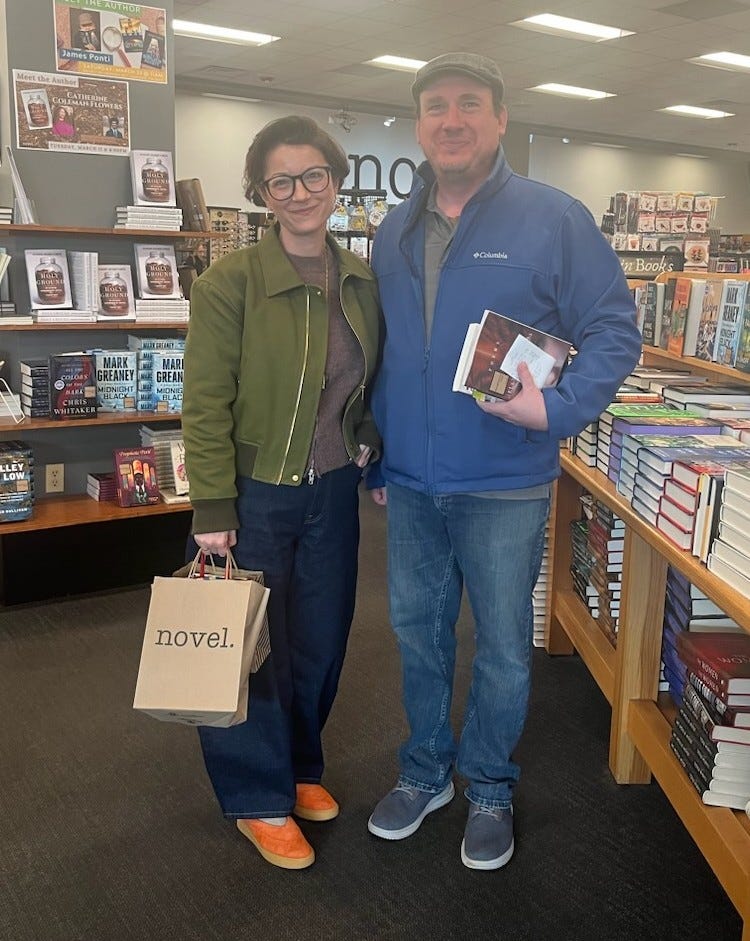
Make the spaces you want to hang out in. - This one hit me hard. Wow! This was my entire goal when I started Beyond the Bookshelf in October 2023. I wanted a little space online to share my love for life and books, and how they connect. I do think I have been successful at this to a degree. But this last year it felt more like work than joy. I don’t want to hang out at work anymore. I want to hang out in the corner of the cafe with some friends talking about books and ideas and how we incorporate those things into our lives. How do the books we read impact us? How do our lives influence the books we choose to read? I want Beyond the Bookshelf to be that space online. I would love to someday meet a few folks in person the way that Petya K. Grady and I met up for lunch at a local bookstore/restaurant. That all starts here though, in this space, and I am the one who makes that space where others feel comfortable being a part of something. A place I want to hang out in with my friends.
I didn’t make any huge resolutions for the new year. In my view it is another day in which time passes. But I did refocus my mind on the things that are important to me. At the end of my life if no one recalls that I wrote this publication that will be ok. But I do want them to think of me as a good person. I want people to say I was kind. That I valued others. That I was a good, not perfect, but good husband and father. That I cared about people.
Thank you Barrie for helping me to capture so beautifully the essence of what I want my life to look like. Hopefully in some small ways I can make progress on those things this year.
“I hate when people say you don’t owe anyone anything. Actually, no, I think as a bare minimum we owe each other basic human kindness and respect.”
- Hazel Satija
Music:
Those of you who have been following me for a bit know of my love for jazz and Paolo Fresu is one of my favorite artists. This album is an eclectic collection which I particularly enjoy.
My son David Long (22), recommends this album:
My daughter Anamaria (18), recommends this album:
Links of interest:
Celine Nguyen sharing why writing is an inherently dignified human activity.
Rafqa Touma found herself in a binge-slump reading cycle from following recommendations on social media. Could booksellers in actual bookshops help?
Katrina Donham explores how Ludwig Bemelman’s children’s books impacted her in much the same way as Homer did. Read her recent essay, Swanksgiving.
Martha Nichols reviews the new show Pluribus in her excellent piece The Worst Dystopias Come From Us.
Joel J Miller provides 10 Tips to Read More. His recommendations are all exceptional and are similar to how I was able to double my reading over the course of a couple of years.
Personal Reading:
I’ve highlighted one fiction and one nonfiction title as my top recommendations from this list.
Recommendations:
Fiction - Wool by Hugh Howey. Howey’s self-published phenomenon deserves its cult following—this is dystopian fiction that earns its bleakness through meticulous world-building rather than apocalypse porn. The underground silo society feels genuinely lived-in, its rules and rituals emerging organically from survival necessity rather than authorial contrivance. The opening mystery—why do people who express desire to leave get their wish, sent outside to die cleaning the silo’s lone window—hooks immediately, but Howey resists easy answers. What distinguishes Wool is its refusal to rush. The mystery unfolds with patient precision, each revelation complicating rather than simplifying the moral landscape. Juliette, the mechanic-turned-sheriff, carries the narrative with blue-collar competence—she’s problem-solver first, rebel second, which makes her eventual defiance land harder. Howey understands that resistance gains meaning through accumulated small refusals, not sudden enlightenment. The prose won’t win literary awards, and the self-published origins show occasionally in pacing choices. But Howey grasps something essential about effective genre fiction: tension builds through specificity. The silo’s vertical geography, its mechanical systems, its social hierarchies—these aren’t backdrop but architecture shaping every choice characters make. By the final pages, you’re desperate to understand this world’s terrible logic. More importantly, you believe people might actually live this way.
Nonfiction - Larry McMurtry: A Life by Tracy Daugherty. Tracy Daugherty’s biography captures Larry McMurtry as both literary icon and restless contradiction—a small-town Texas bookman who became Hollywood’s favorite Western novelist while maintaining genuine ambivalence about both identities. Daugherty traces McMurtry’s evolution from cattle country to the Pulitzer Prize, examining how a writer simultaneously celebrated and dismissed the mythic West that made him famous. The biography excels at contextualizing McMurtry’s sprawling output—novels, screenplays, essays, even rare book dealing—within the larger currents of American literature and the transformation of the Texas he both loved and outgrew. Daugherty doesn’t shy from McMurtry’s contradictions: the sophisticated bibliophile who wrote “Lonesome Dove,” the urban intellectual who never quite left Archer City. What emerges is a portrait of American letters’ most productive skeptic, a writer who spent fifty years interrogating the myths that sustained his career. Essential reading for anyone interested in regional literature’s relationship with national identity.
All the rest:
The Constellation of Forgotten Things by Tiffany Chu. I was provided an advance reader copy by the author. I read a lot of fantasy, but I’m usually drawn to the epic and the morally complex—stories where the world-building serves larger philosophical questions. That’s not what Tiffany Chu and Renley Nicolas Chu set out to create in The Constellation of Forgotten Things, and that’s fine. They built something different: a collection of emotionally rich, character-focused stories set in an original fantasy realm called Reveria. What impressed me most was the craftsmanship underlying the emotional beats. Each story stands alone, but they’re all connected by Reveria’s internal logic—its magic systems, its geography, its rules. That kind of consistency across a short story collection is harder than it looks, and the Chus pull it off without making the connective tissue feel forced. “A Tale of Two Brothers” particularly demonstrates this balance, delivering genuine emotional weight while staying true to the world they’ve built together. This is fantasy for readers who want to feel something—who prioritize relationships and emotional stakes over intricate plotting or moral ambiguity. If you’re drawn to stories about found family, sacrifice, and characters working through heartache in magical settings, you’ll find much to love here. The collaborative achievement deserves recognition on its own merits. Tiffany and Renley created an entire realm together, story by story, building something that belongs to both of them. That Renley passed away a few years ago makes this collection a testament to their shared imagination, but it’s the quality of that imagination—not the tragedy—that makes it worth reading. They built Reveria together, and it holds.
The Boys from Biloxi by John Grisham. Grisham abandons the courtroom thriller formula for something darker and more ambitious—a multi-generational Gulf Coast saga tracking two Biloxi boyhood friends whose families land on opposite sides of Mississippi’s endemic corruption. One becomes a crusading prosecutor; the other inherits his father’s vice empire of casinos, strip clubs, and political payoffs. Set against the seedy glamour of mid-century coastal Mississippi, this is Grisham doing Southern crime fiction with unexpected patience and moral complexity. Less legal procedural, more family tragedy. The sprawling timeline and dual-family structure recall classic American crime sagas, though Grisham’s clean prose never quite matches the subject’s tawdry depths.
Engaging throughout, if ultimately more accomplished than revelatory.
A Wizard of Earthsea by Ursula K. LeGuin. LeGuin’s 1968 masterwork remains startling in its refusal of fantasy’s usual comforts. Young Ged’s magical education becomes something stranger than hero’s journey—a reckoning with pride, power, and the shadow-self we unleash through ambition. The prose carries folkloric weight without archaic affectation, and LeGuin’s archipelago world feels lived-in rather than constructed. But what elevates this beyond genre is its psychological honesty: magic here isn’t empowerment fantasy but dangerous self-knowledge, and coming-of-age means learning what not to do with power. Decades before “dark fantasy” became marketing copy, LeGuin understood that genuine darkness lives in the wizard’s own heart. Brief, devastating, essential.
The Tombs of Atuan by Ursula K. LeGuin. LeGuin shifts perspectives entirely for this Earthsea sequel, trading the wizard’s journey for something claustrophobic and quietly radical—a girl raised from childhood to serve nameless gods in desert catacombs, her identity erased, her world reduced to darkness and ritual. Tenar’s captivity is both literal and spiritual, and LeGuin maps the psychology of indoctrination with unsettling precision. When Ged finally appears, he’s less rescuer than catalyst for a choice only Tenar can make. The book becomes a meditation on what we inherit versus what we choose, on breaking free from systems that name us before we can name ourselves. Darker and more interior than Wizard, it’s LeGuin at her most psychologically acute.
The Guardians by John Grisham. Grisham trades courtroom drama for something grittier—a small nonprofit lawyer hunting for evidence to free a man twenty years into a life sentence for a murder he didn’t commit. The machinery of wrongful conviction gets methodical attention: coerced confessions, junk forensics, witness intimidation, judicial indifference. What distinguishes this from Grisham’s glossier legal thrillers is its ground-level view of innocence work—the tedious document review, the dead-end interviews, the fact that exoneration rarely arrives through dramatic courtroom reveals. The prose remains workmanlike, occasionally too efficient for the moral weight it carries.
Grisham clearly cares about the subject. The result is earnest, competent advocacy fiction—admirable if rarely transcendent.
Foundations Edge by Isaac Asimov. Asimov returns to his Foundation universe three decades later with ambitions toward something more intimate than the original trilogy’s grand historical sweep. The galactic chess match between Foundations continues, but now filtered through actual character psychology rather than pure ideological abstraction. The result feels transitional—Asimov clearly wants deeper human complexity but his prose remains too functional for the emotional stakes he’s reaching toward. The conceptual machinery (new players, ancient mysteries, the nature of psychohistory itself) engages, but you sense a writer whose gifts lie in ideas rather than interiority. Foundation completists will find necessary developments. Newcomers should start with the original trilogy, where Asimov’s limitations matter less.
Since We Fell by Dennis Lehane. Lehane abandons his Boston crime fiction wheelhouse for domestic psychological thriller—Rachel, a former journalist undone by trauma and family secrets, whose second marriage to a mysterious boat captain unravels into paranoia and deception. The first half tracks Rachel’s psychological deterioration with genuine patience, Lehane mapping the architecture of anxiety and agoraphobia without melodrama. Then the book pivots hard into Hitchcockian twists and international intrigue, and the tonal whiplash proves difficult to reconcile. What began as intimate character study becomes increasingly implausible setup and reversal. I am a big fan of Lehane and here his prose remains sharp throughout, but you sense a writer uncertain whether he’s writing literary suspense or airport thriller. The ambition deserves credit; the execution never quite coheres.
America is the Poem by Joseph Massey. Short, patriotic collection of poems. I purchased a signed copy from the author after reading about the collection online. I don’t feel qualified to review a poetry collection but it was interesting.
Go Tell It on the Mountain by James Baldwin. No review of this one at this time. I will discuss it in depth in the book club essay at the end of the month.
*You can click on the title of any book to purchase your own copy. These are affiliate links from Bookshop.org, earning me a very small commission for any purchase you make.
Video:
My friend, Cams Campbell, is leading a read-along which I am participating in. He has a great Substack publication, a great YouTube channel, and a great accent! Check out what he has on offer.
Matthew’s Lifetime Reading List ← Click that link to see everything I have read since 1997!
Here’s to the books that take us beyond the shelf and into deeper waters,


Matthew Long is a writer and retired sailor living in rural western Tennessee.
Beyond the Bookshelf is a reader-supported voyage. If these literary explorations have enriched your journey, I’d be grateful for any support you can offer. Whether it’s the price of a coffee or a book, your contribution keeps wind in our sails and ensures these navigations through literature remain accessible for all readers. Thank you for being part of this crew.
Affiliate links: You can click on the title of any book mentioned in this article to purchase your own copy. These are affiliate links from Bookshop.org, earning me a very small commission for any purchase you make.
Thank you for this reflection, Matthew. It echoes much of what has been on my mind lately. I also find it difficult not to read what comes in, and so regularly have to limit my subscriptions. If you feel called to cancel mine at anytime, feel free. I always try to think that when people walk away, it is because it is the right time to do so. Wishing you health and good wishes as we move into this new year 🙏
I am so glad I stumbled across your sub stack. So many books capturing my attention, especially the LeGuin summaries, which I will have to revisit. Thank you for your thoughtful discussions on reading and life fellow veteran!