

Peace
The Odyssey Book 24

Navigating the passages between books and being
“But you, Odysseus, your fame will never die... What glory the gods have given Penelope, Icarius’s daughter, what good sense, how loyal she was to Odysseus, the man she married! Her fame will last forever, the immortals will compose a song to praise her constancy.”
Dear friends,
Book 24 of Homer's The Odyssey is the epic’s complex and multifaceted conclusion, bringing together the various narrative threads while establishing frameworks for lasting resolution beyond individual revenge or family reunion. This final chapter operates on multiple levels simultaneously: as a meditation on death and the afterlife, as a reconciliation between father and son, as a confrontation between competing claims to justice, and ultimately as a divinely ordained establishment of peace that prevents cycles of vengeance from perpetuating indefinitely. The book demonstrates Homer’s understanding that true resolution requires more than personal satisfaction or dramatic climax—it demands social reconciliation and the establishment of structures that enable lasting peace.
The significance of Book 24 extends far beyond its immediate function as narrative closure to encompass Homer’s most complete exploration of how communities recover from violence, restore social order, and break cycles of retribution that threaten to destroy society. The chapter’s movement from the underworld scene depicting the suitors’ arrival among the dead, through Odysseus’s reunion with his aged father Laertes, to the final confrontation with the suitors’ relatives and the divinely imposed peace demonstrates sophisticated understanding of how resolution operates on multiple levels—personal, familial, social, and cosmic.
Moreover, Book 24 serves as the epic’s final statement about the relationship between human agency and divine intervention in establishing justice and maintaining social order. Through Athena’s ultimate intervention to stop the cycle of revenge, Homer explores how lasting peace sometimes requires supernatural authority to override human impulses toward continued violence. The chapter demonstrates that while justice demands punishment of wrongdoing, wisdom recognizes when vengeance must be curtailed to prevent endless cycles of retaliation that serve no constructive purpose.
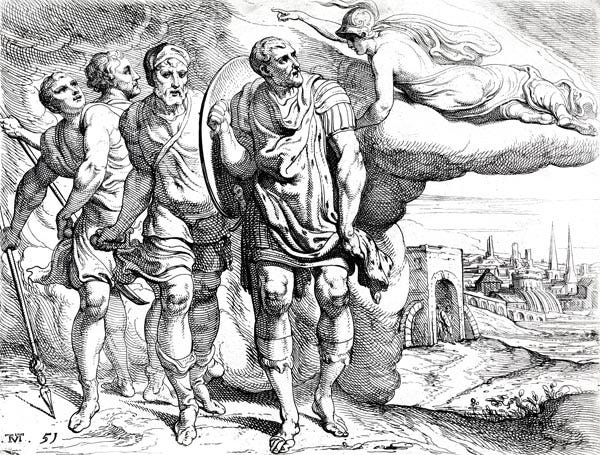
Book 24 opens with one of ancient literature’s most remarkable scenes: Hermes Psychopompus (the guide of souls) conducting the suitors’ shades to the underworld. The detailed description of their journey through various mythological landmarks creates a sense of finality while emphasizing the irreversible nature of death and divine judgment. The suitors’ procession to the realm of the dead demonstrates how their violation of fundamental social and religious obligations has resulted in not just physical death but spiritual condemnation.
The underworld encounter between the newly arrived suitors and the shades of Achilles and Agamemnon provides opportunities for reflection on different forms of heroic death and posthumous reputation. Agamemnon’s conversation with Achilles about the latter’s magnificent funeral and continuing fame demonstrates ancient Greek concerns about kleos (glory/reputation) and how individuals are remembered after death. The scene establishes frameworks for evaluating different types of heroic life and death while providing context for understanding the suitors’ ignoble end.
Amphimedon’s account to Agamemnon of events in Ithaca—including Penelope’s weaving stratagem and the circumstances of the suitors’ death—provides an external perspective on the epic’s main narrative while allowing Homer to revisit key themes. The suitor’s explanation emphasizes Penelope’s cunning and Odysseus’s strategic superiority while inadvertently validating the justice of their punishment through his description of their own behavior.
Agamemnon’s response to Amphimedon’s tale provides the underworld’s judgment on Odysseus and Penelope’s relationship, contrasting their successful partnership with his own disastrous marriage to Clytemnestra. His praise for Penelope’s loyalty and wisdom demonstrates how the couple’s successful reunion validates their individual choices during separation while establishing their relationship as a model of proper marital partnership. His prophecy that Penelope’s fame will endure forever provides cosmic validation for her constancy while suggesting how genuine virtue creates lasting reputation.
The narrative shifts from the underworld to Odysseus’s journey to his father Laertes’s farm in the countryside, where the aged king has withdrawn in grief over his son’s absence. This movement from the realm of the dead to scenes of potential renewal demonstrates structural sophistication while advancing themes about restoration, reconciliation, and the continuing cycles of life despite tragedy and loss.
The description of Laertes’s self-imposed exile and his deliberate degradation—wearing ragged clothing, sleeping in the servants’ quarters, tending his garden in grief—provides one of the epic’s most moving portraits of parental suffering. His voluntary adoption of beggar-like conditions mirrors his son’s enforced disguise while demonstrating how grief can transform even kings into shadows of their former selves. The scene emphasizes the human cost of Odysseus’s long absence while creating conditions for dramatic reunion.
Odysseus’s initial decision to test his father rather than revealing himself immediately has troubled readers since antiquity, as it appears to prolong unnecessarily the old man’s suffering. However, this final test serves multiple functions: it demonstrates Odysseus’s habitual caution even in apparently safe circumstances, it provides opportunities for Laertes to demonstrate his continuing dignity despite his degraded condition, and it creates dramatic tension that makes their eventual reunion more emotionally powerful.
The false tale Odysseus tells his father—claiming to be a stranger who once hosted Odysseus—follows the same pattern of strategic lying that has characterized his return to Ithaca. His detailed description of his supposed hospitality to Odysseus provides another test of loyalty and grief while revealing information about Laertes’s emotional state and continuing devotion to his absent son.
Laertes’s response to the stranger’s news—his overwhelming grief at hearing that his son was alive five years ago but might now be dead, his aging body’s physical collapse under emotional stress—demonstrates both the depth of his love and the physical toll that prolonged grief has exacted. His despair at receiving partial hope followed by renewed uncertainty creates one of the epic’s most emotionally wrenching moments while testing Odysseus’s resolve to maintain his deception.
Odysseus’s revelation of his identity to his father, prompted by recognition that further testing serves no purpose and might literally kill the old man, demonstrates both his capacity for appropriate timing and his genuine love for his father. His proof of identity through the scar and his detailed recollection of the orchard trees Laertes gave him as a child provides verification through shared intimate knowledge while emphasizing the continuity of family relationships across time and separation.
The reunion between father and son provides emotional catharsis while completing the restoration of the family’s three generations. Laertes’s transformation from grief-stricken shadow to revitalized elder demonstrates how recognition and reunion can restore vitality even to those who have suffered prolonged despair. His concern about potential retaliation from the suitors’ families reveals continuing practical wisdom despite his emotional overwhelm.
Meanwhile, news of the suitors’ slaughter spreads through Ithaca, prompting the victims’ families to gather and debate appropriate response. The discovery of the corpses and the realization of the massacre’s scale creates conditions for potential civil war as the suitors’ relatives face choices about whether to accept Odysseus’s justice or seek revenge for their dead kinsmen.
The assembly scene where the suitors’ relatives debate their response demonstrates ancient Greek political processes while exploring how communities navigate between competing claims to justice. Eupeithes, father of the slain Antinous, argues for immediate retaliation, claiming that Odysseus’s actions warrant counter-violence regardless of the suitors’ guilt. His speech reveals how grief can override rational judgment while showing how cycles of vengeance can perpetuate indefinitely when each side views its own violence as justified response to previous wrongs.
The opposing perspective provided by the elder Halitherses and Medon emphasizes divine sanction for Odysseus’s actions and the suitors’ responsibility for their own fate. Their arguments appeal to religious authority and moral causation, suggesting that seeking revenge against divinely authorized justice would be impious and futile. The debate reveals how communities divided by violence must choose between perpetuating cycles of retaliation or accepting difficult truths about guilt and consequence.
The decision of roughly half the assembly to pursue revenge despite warnings demonstrates how grief and anger can override prudent counsel while creating conditions for the final armed confrontation. The suitors’ relatives’ march toward Laertes’s farm with hostile intent necessitates the divine intervention that will ultimately establish peace.
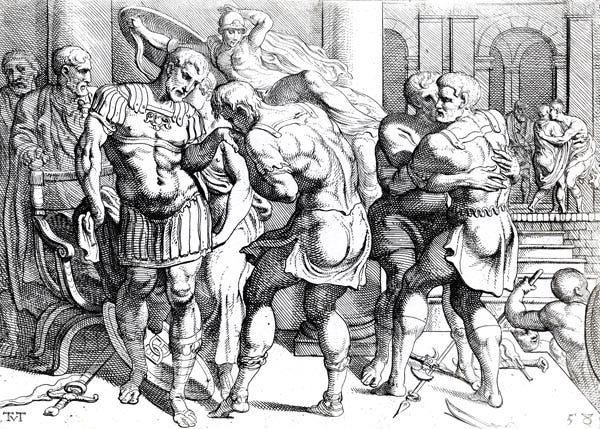
Athena’s intervention to revitalize Laertes for battle provides both divine validation for the family’s cause and practical assistance in the coming confrontation. Her enhancement of his physical capabilities enables him to strike the first blow, killing Eupeithes with a spear-cast that demonstrates both divine favor and the continuing martial prowess of Odysseus’s lineage across three generations.
The brief battle between Odysseus’s family (including the newly invigorated Laertes and the loyal servants) and the suitors’ relatives demonstrates both sides’ commitment to their causes while building toward the divinely imposed resolution. Odysseus’s eagerness to continue fighting and his momentum toward total victory over his opponents shows how violence, once initiated, develops its own logic and momentum that can be difficult to arrest.
Athena’s dramatic intervention to stop the battle, speaking with Zeus’s authority, provides the mechanism for breaking the cycle of violence before it can perpetuate into ongoing civil war. Her command that both sides cease fighting, followed by Zeus’s thunderbolt that reinforces divine authority, demonstrates how lasting peace sometimes requires supernatural intervention to override human impulses toward continued retaliation.
The establishment of formal peace through oaths and divine sanction creates the conditions for social reconciliation and lasting resolution. The agreement that Odysseus will continue to rule Ithaca while the suitors’ families will forgo revenge involves compromises from both sides while establishing frameworks for coexistence despite recent violence. The divine guarantee of this peace provides authority beyond human agreement alone.
The epic’s conclusion with divinely imposed peace demonstrates Homer’s understanding that true resolution requires more than military victory or personal satisfaction—it demands establishment of structures and agreements that enable communities to move beyond violence toward stable social order. The somewhat abrupt ending, which has troubled some readers, reflects the reality that peace often comes not through organic resolution of all conflicts but through authoritative interventions that establish frameworks for ending cycles of violence.

Literary Analysis
The Underworld Scene and Poetic Justice
Book 24’s opening underworld scene provides cosmic perspective on the epic’s main narrative while offering divine judgment on the characters and events. The suitors’ arrival among the dead and their conversations with established residents of Hades creates opportunities for reflection on different forms of life, death, and posthumous reputation that illuminate the epic’s value system.
Agamemnon’s praise for Penelope and contrast with his own disastrous marriage to Clytemnestra provides the underworld’s validation for the successful partnership between Odysseus and Penelope. His prophecy that Penelope’s fame will endure forever through song establishes her constancy and wisdom as worthy of eternal memory, placing her among the epic’s most admirable characters while demonstrating how genuine virtue creates lasting reputation.
The underworld scene also serves to emphasize the finality and irreversibility of the suitors’ punishment. Their presence among the dead, their account of their own destruction, and their acknowledgment (however grudging) of Odysseus’s superior cunning demonstrate that justice has been definitively administered. The cosmic setting removes any doubt about the appropriateness of their fate while showing how their deaths serve as cautionary tale for future generations.
Father-Son Relationships and Generational Continuity
Book 24’s focus on the reunion between Odysseus and Laertes completes the epic’s exploration of father-son relationships across three generations. Where earlier books developed the relationship between Odysseus and Telemachus, the final book demonstrates how these bonds extend both forward and backward through family lineages to create continuity across time.
Laertes’s grief-stricken condition and his subsequent revitalization through reunion with his son demonstrates how family relationships can provide sources of meaning and vitality even for those who have suffered profound loss. His transformation from despairing shadow to effective warrior shows how recognition and reconciliation can restore not just emotional wellbeing but practical capability and will to live.
The three generations fighting together in the brief battle—Laertes, Odysseus, and Telemachus united in defending their family against the suitors’ relatives—provides powerful imagery of family solidarity and continuity. Their coordination demonstrates how effective families transmit values, capabilities, and loyalty across generations while showing how proper family relationships create bonds that transcend individual interests.
Cycles of Vengeance and Divine Intervention
The chapter’s central thematic concern involves the problem of endless cycles of revenge and the question of how communities break patterns of retaliation that threaten to destroy social order. The suitors’ relatives’ determination to avenge their dead kinsmen, despite the suitors’ own guilt and the divine sanction for their punishment, demonstrates how violence creates its own logic that can perpetuate indefinitely when each side views its actions as justified response to previous wrongs.
Athena’s intervention to impose peace by divine authority represents Homer’s recognition that lasting resolution sometimes requires external force to override human impulses toward continued violence. Her command, backed by Zeus’s thunderbolt, provides authority that transcends human claims to justice while establishing frameworks for coexistence that allow communities to move beyond violence toward stable order.
The somewhat abrupt nature of this divine intervention has troubled readers who prefer organic resolution through human choice alone. However, Homer’s approach reflects realistic understanding that peace often comes not through natural cessation of conflict but through authoritative interventions—whether divine, political, or social—that establish terms for ending cycles of violence that serve no constructive purpose.
Justice, Mercy, and Proportionality
Book 24’s exploration of how communities respond to violence raises profound questions about the relationship between justice and mercy, punishment and forgiveness, that remain unresolved and debatable. The debate in the assembly between those advocating revenge and those counseling acceptance of divine judgment demonstrates competing legitimate concerns about accountability, closure, and social stability.
The chapter suggests that while justice demands punishment of wrongdoing, wisdom recognizes limits to retribution and the importance of preventing endless cycles of revenge. The divine intervention that stops further violence operates as mercy for the suitors’ families while serving social necessity by preventing civil war. This combination of justice (the suitors’ punishment) and mercy (preventing retaliation against Odysseus) demonstrates sophisticated understanding of how communities balance competing moral and practical concerns.
However, the chapter does not fully resolve questions about proportionality or collective guilt that have troubled readers throughout Book 22. The suitors’ relatives’ grief for their dead sons and brothers receives acknowledgment without validation, while the divine sanction for their deaths provides authority without necessarily addressing all moral concerns about the extent and nature of punishment administered.
Divine Authority and Political Legitimacy
The epic’s conclusion with divinely imposed peace provides the final statement about the relationship between supernatural authority and human political order. Athena’s intervention on behalf of Odysseus demonstrates continued divine favor while establishing his rule on foundations that transcend mere military victory or hereditary claim.
The formal peace agreement guaranteed by divine oath creates structures for legitimate governance that combine human political arrangements with supernatural validation. Odysseus’s continued rule over Ithaca depends not just on his successful defeat of rivals but on divine authorization that places his authority beyond merely human challenge.
This integration of divine and human authority reflects ancient Greek political concepts where legitimate rule required both practical capability and religious sanction. The gods’ support for Odysseus throughout his journey and their ultimate establishment of peace under his rule demonstrates how effective governance was understood to require alignment between human virtue and divine favor.
Reconciliation and Social Healing
Book 24’s movement from violence through confrontation to divinely imposed peace demonstrates understanding of how communities recover from civil conflict and establish conditions for future coexistence. The process involves acknowledgment of wrongs committed, acceptance of consequences administered, and agreement to forgo further retaliation in favor of stable social order.
The suitors’ families’ agreement to accept peace despite their grief involves genuine sacrifice and difficult compromise. Their decision to forgo revenge despite strong emotional impulses toward retaliation demonstrates the kind of restraint and acceptance of larger social needs that enables communities to move beyond cycles of violence toward functional coexistence.
The divine guarantee of this peace provides authority and assurance beyond human agreement alone while establishing sacred obligations that make oath-breaking not just socially destructive but religiously transgressive. This combination of human agreement and divine sanction creates the strongest possible foundation for lasting peace.
Historical and Cultural Context
Book 24 provides insights into ancient Greek concepts of death, the afterlife, family relationships, political processes, and conflict resolution while serving narrative functions within the epic’s fictional framework. The detailed description of the underworld and its inhabitants reflects documented ancient beliefs while serving thematic purposes related to judgment, reputation, and cosmic justice.
The assembly scene where citizens debate appropriate response to the suitors’ deaths illuminates ancient Greek political processes and concepts of collective decision-making. The competing speeches, the divided vote, and the partial mobilization for revenge all reflect realistic political dynamics while showing how communities navigated between competing claims and interests.
The divine intervention to impose peace corresponds to ancient Greek religious concepts while reflecting realistic understanding that conflicts often require external authority to achieve resolution. The oaths and formal agreements guaranteed by divine sanction reflect actual ancient practices for establishing binding commitments that carried both political and religious authority.
Contemporary Relevance
The themes explored in Book 24 maintain profound relevance for contemporary readers dealing with questions about justice, revenge, reconciliation, and how communities recover from violence. The chapter’s exploration of cycles of vengeance and the challenge of breaking patterns of retaliation speaks directly to contemporary conflicts ranging from personal feuds to international violence.
The debate between those advocating continued revenge and those counseling acceptance of judgment reflects ongoing contemporary discussions about restorative versus retributive justice, the role of forgiveness in social healing, and how communities balance demands for accountability with needs for reconciliation and forward movement.
The divine intervention that imposes peace by external authority provides frameworks for thinking about how conflicts are actually resolved in practice—often not through organic cessation of violence but through interventions by authorities, mediators, or institutions that establish terms for ending cycles of retaliation. The somewhat artificial nature of this imposed peace reflects realistic understanding that lasting resolution often requires external pressure rather than developing naturally from the parties’ own choices.
The chapter’s exploration of how grief and anger can override rational judgment speaks to contemporary understanding of trauma, loss, and the challenge of making wise decisions while experiencing intense emotions. The suitors’ relatives’ determination to seek revenge despite warnings demonstrates how personal suffering can create impulses toward violence that ignore larger social consequences.
Perhaps most significantly, Book 24’s demonstration that true resolution requires more than military victory or legal judgment to encompass social reconciliation and establishment of structures for coexistence speaks to contemporary challenges involving post-conflict reconstruction, transitional justice, and the creation of conditions for lasting peace after violence.
Conclusion
Book 24 of The Odyssey provides a complex, multifaceted conclusion that brings together the epic’s various narrative threads while establishing frameworks for lasting resolution beyond individual satisfaction or dramatic climax. The chapter’s movement from the underworld through family reunion to imposed peace demonstrates Homer’s sophisticated understanding that genuine resolution operates on multiple levels—personal, familial, social, and cosmic.
The underworld scene provides divine perspective on the epic’s main narrative while validating the successful partnership between Odysseus and Penelope through Agamemnon’s praise. The cosmic setting emphasizes the finality of the suitors’ punishment while demonstrating how their deaths serve as cautionary tale that will be remembered through song across generations.
The reunion between Odysseus and Laertes completes the epic’s exploration of family relationships while demonstrating how recognition and reconciliation can restore vitality even to those who have suffered prolonged despair. The three generations fighting together provides powerful imagery of family solidarity while showing how proper relationships create bonds that transcend individual interests.
The confrontation with the suitors’ relatives and the divine intervention to impose peace demonstrates Homer’s engagement with fundamental questions about cycles of revenge and how communities break patterns of violence that threaten social order. Athena’s authoritative establishment of peace reflects realistic understanding that resolution often requires external intervention to override human impulses toward continued retaliation.
The somewhat abrupt ending, which has troubled some readers who prefer more organic resolution, reflects Homer’s sophisticated understanding that peace often comes not through natural cessation of conflict but through authoritative interventions that establish terms for ending violence. The divine guarantee of peace provides the strongest possible foundation for lasting resolution while acknowledging that perfect resolution of all moral questions may not be possible.
As the epic concludes with divinely imposed peace, Homer demonstrates that true resolution requires more than personal satisfaction or military victory—it demands establishment of structures and agreements that enable communities to move beyond violence toward stable social order. The chapter’s integration of personal reunion, family restoration, and social reconciliation creates comprehensive conclusion that addresses the epic’s concerns on all levels simultaneously.
The enduring significance of Book 24 lies in its sophisticated exploration of how individuals and communities recover from violence, restore relationships, and establish conditions for lasting peace. Homer’s willingness to engage with these complex questions without providing simple answers demonstrates understanding that the greatest literature illuminates enduring challenges rather than offering easy solutions.
The epic’s conclusion validates the successful partnership between Odysseus and Penelope, restores proper authority in Ithaca, reunites the family across three generations, and establishes peace through divine intervention—yet it acknowledges that these resolutions involve compromises, unresolved tensions, and ongoing challenges that will require continued wisdom and effort to manage. This realistic conclusion honors both the epic’s heroic elements and its sophisticated understanding of how human societies actually function.
Study Questions
Cycles of Vengeance and Breaking Violence: The suitors’ relatives’ determination to avenge their dead kinsmen, despite the suitors’ own guilt and divine sanction for their punishment, demonstrates how violence creates cycles of retaliation that can perpetuate indefinitely. How does Homer explore the problem of endless revenge, and what does the divine intervention to impose peace suggest about how such cycles are actually broken? What relevance might this ancient exploration of vengeance cycles have for contemporary conflicts ranging from personal feuds to international violence? When, if ever, is external intervention necessary to stop cycles of retaliation?
Testing and Reunion with Laertes: Odysseus’s decision to test his father rather than revealing himself immediately—thereby prolonging the old man’s suffering—has troubled readers since antiquity. How should we evaluate this final test in light of Odysseus’s character and the pattern of strategic caution that has characterized his return? What does this scene suggest about the relationship between caution and cruelty, or between strategic thinking and human compassion? How might contemporary readers balance understanding of the psychological effects of trauma (which might explain Odysseus’s habitual caution) with moral concerns about unnecessary suffering?
Divine Intervention and Human Agency: The epic’s conclusion with Athena imposing peace by divine authority rather than allowing humans to reach their own resolution has troubled some readers who prefer organic endings. What does this divine intervention suggest about Homer’s understanding of how conflicts are actually resolved and peace established? How does this somewhat abrupt ending reflect on the relationship between human agency and external authority in creating lasting peace? What contemporary parallels might exist for situations where conflicts require external intervention rather than resolving through the parties’ own choices?

Reading Assignment for Next Week
We have completed our reading of Homer’s epic poem, The Odyssey. Next week will be a wrap-up of the experience.
Here’s to the books that take us beyond the shelf and into deeper waters,


Matthew Long is a writer and retired sailor living in rural western Tennessee.
Beyond the Bookshelf is a reader-supported voyage. If these literary explorations have enriched your journey, I’d be grateful for any support you can offer. Whether it’s the price of a coffee or a book, your contribution keeps wind in our sails and ensures these navigations through literature remain free for all readers. Thank you for being part of this crew.
Affiliate links: You can click on the title of any book mentioned in this article to purchase your own copy. These are affiliate links from Bookshop.org, earning me a very small commission for any purchase you make.
Previous articles in this series:
If you are a new subscriber or missed any of the previous articles in this series, you can catch up at the link below:


Matthew, this has been such a pleasure reading The Odyssey all of these weeks. Your detailed leadership in the book discussions shares nuances I might have missed and connections that are so very valuable to essentially all human relationships.
I am in the camp that the final book is truncated but how does one tie off a story that has weaved themes and ambitions otherwise. Considering the overall take-aways of relationships, acknowledgement of wrongs, acceptance of consequences, even with difficult compromises, and grief - its depth, does allow one to pause long enough to look at the world just a little differently.
Afterlife, the walking towards its inevitably in, "... the fields of asphodel where the dead, the burnt-out wraiths of mortals, make their home" (393) is fascinating to me. How Homer and the Greek mythology shares a space for those stories gives additional bereavement, misery even, to our individual choices, intentionality, and purposefulness. Maybe what The Odyssey suggests is a self-accounting of how one wants to be remembered?
Hi Matthew, I just finished the fall term of the Catherine Project, reading The Iliad and The Odyssey, and I just came back to read through your reflections. It was a wonderful way to look back on reading these great works! Wishing you and your family a joyful holiday season.