

Personal Canon Formation - An interview with John Halbrooks
A Beyond the Bookshelf Profile


Navigating the passages between books and being
Dear friends,
I don’t recall exactly when or how John Halbrooks and I first met, but it was soon after I found my way to Substack. In those early days, there were fewer writers and fewer publications. We were a small, tight-knit group, which allowed us to build lasting friendships. I admired John from the beginning. He was an academic in a field I valued. I loved the name of his publication, Personal Canon Formation, which is a topic I had been thinking on for several years. What goes into the development of a personal canon? How does that canon live with us and change over the course of our lives? John has deeply explored the arts and taught me much about literature, art, and music.
This week, John and I are collaborating: yesterday he published a guest essay I wrote, and today I am publishing this interview, which takes us on an exploration Beyond the Bookshelf to get to know John better. I am grateful John agreed to answer a few of my questions. I highly recommend subscribing to his publication. You will be glad you did.
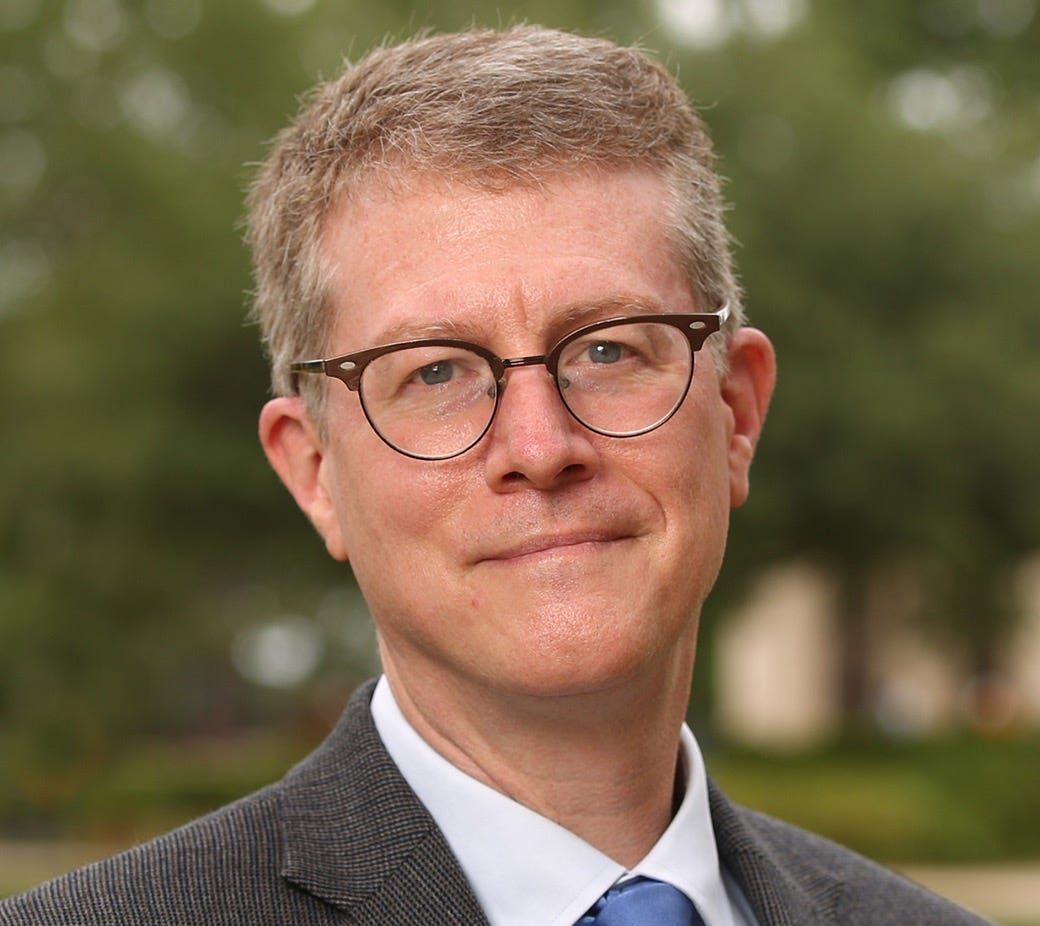
Let’s start at the beginning. Where did you grow up, and what was your childhood like? Were you always a reader and music lover, or did those passions develop over time?
I was born in Atlanta but grew up mostly in North Carolina, where my father worked as an academic historian–and so books were essential to my life from the beginning. He also had a record collection of classical music, which I discovered early. I started piano lessons very early–and later added voice, guitar, and clarinet. So music and reading were central from the beginning.
You attended UNC Chapel Hill, where you spent hours in the music library listening room. Can you paint a picture of what that experience was like? What were you discovering there, and how did it shape your aesthetic sensibility?
The memory of the music library at Chapel Hill was one of the main inspirations for Personal Canon Formation. Music discovery in the 1980s took work. There was no universal jukebox like Spotify: you heard music on the radio, or you sought it out through buying or borrowing records, or you sought out live music. When I got to college, the music library was this sort of wonderland where I could listen to anything that captured my curiosity.
This was, however, an embodied experience: there was a listening room, where you could take the vinyl records or CDs and listen to them with headphones. There were, I think, spaces for a couple dozen people to listen, and before exams (with music-history “drop-the-needle” tests), these would fill up. But for most of the semester, there were just a few of us diehards who camped out there, spending hours listening.
So from very early, I sought out music, rather than letting commercial radio (the “Spotify algorithm” of the time) determine my taste–though I did listen to a lot of radio too.
At what point did you realize you wanted to pursue academia? Was there a particular teacher, book, or moment that crystallized that decision for you?
At some point in my second year of college, I realized a couple of things. First, I realized that the music major was so time-consuming that it meant that I would not have much freedom to continue my literary studies in the classroom if I were to continue. Second, I realized that my musical talents were not sufficient for me to pursue a career exclusively in vocal performance, and I had no real interest in teaching voice lessons all my life. So I switched to the English major at the beginning of my third year, and since I had an academic father, that career model was familiar to me. And I didn’t want to go to law school.
What drew you specifically to medieval and Renaissance literature? These periods can seem remote to many people—what made you fall in love with texts that are centuries old?
I had great teachers. But when I started my doctoral program at Tulane, I still wasn’t sure about my area of specialization. In my first semester of coursework there, I had a seminar with Mike Kuczynski, an amazing scholar and teacher who became my dissertation adviser. Mike is the finest teacher I know, and he opened up these texts for me in new ways. These texts also attract me as a teacher, because students need my help to find a way into them–perhaps more than is the case with the modern novel or Romantic poetry (though, of course, I know great teachers in those fields as well).
You’ve been at the University of South Alabama for your entire career. What made you choose Mobile, and what has living on the Gulf Coast meant to you?
In academia, you don’t really get to choose exactly where you live. Every year, there is a very limited number of jobs in your field, and you go where the job is. Then, once you get tenure, you are kind of stuck, except under special circumstances, because most institutions do not hire to tenure, except for some more administrative jobs. All of that to say: I didn’t choose Mobile. However, I did my doctorate at Tulane in New Orleans, so the transition was fairly natural, since Mobile is just a couple of hours east on the Gulf Coast. There are things that drive me crazy about Alabama–mostly the politics. But Mobile is a special place in a number of ways: it’s old, it’s diverse, and once you find your people, it becomes home. Also, the extremely tight academic job market means that my department has been able to hire outstanding faculty, and I love my colleagues.
The phrase “Personal Canon Formation” is so evocative. Walk me through how this concept emerged and what it means to you beyond the definition you’ve provided.
I sort of told this story in the very first post back in 2023 (for anyone who wants a more expansive answer), but here’s the short version: shortly after the streaming services emerged, I realized that they were problematic in a number of ways. There is, of course, the fact that they pay the artists very poorly, but there are other problems as well. As I mentioned earlier, when I was growing up, the music lover had to seek out music and to invest in it–invest both in terms of time and money. These days, it is fed to you, and unless you are intentional about it, you get caught in an algorithm of sameness. Music becomes wallpaper instead of art.
So, the idea of “personal canon formation” suggests that you have to intentionally seek out art that is important to you, instead of having it simply delivered to you by a corporation. I later discovered that I was not the only one to come up with the phrase, and I briefly thought about changing the name, but my readers encouraged me to stick to my guns.
You’ve written about how Spotify initially seemed like your childhood dream—”the eternal jukebox”—but then became “too easy.” Can you expand on that paradox? What’s lost when everything becomes instantly accessible?
When I was a kid, there was so much music that I read about (in magazines, biographies, etc.), but I could afford to buy only a small percentage of it. I didn’t realize at the time that the effect of this was to make me really treasure and love the music that I did buy. Now, I can listen to anything that I read about instantly, but the result is that there is this flood of music, and it’s difficult to pick out what matters to you. There is so much noise that it’s hard to pick up the signal.
That is why I have started doing my year-end favorites listss: here are titles I have picked out from a huge range of music from this year that I think are worth your attention, across genres; they haven’t been picked out by a corporate algorithm but by a person, with eclectic tastes, who has invested a lot of time trying to find the signal in the midst of the noise. That doesn’t make my selections better than anyone else’s, but at least you know that a real human being has spent a lot of time thinking about them.
Your Substack uniquely combines medieval literature with contemporary music—connecting Icelandic poetry to Prince’s “Purple Rain,” or Tolkien to Vaughan Williams. Where did this approach originate? Do people ever think you’re crazy for making these connections?
Sure, several people have told me that the connections that I make are arbitrary (especially with the Prince/sagas series), but my idea of criticism is that it should be an honest record of how individual readers and listeners have responded to art over time. Some may find my approach strange, but it is honest and authentic. I think that the more years you spend reading and listening, the more connections that you start to make if you pay attention. So, I suppose that this approach originated in my honest experience: the last time I read Egil’s Saga in preparation for teaching it, I kept hearing the Purple Rain album in my head, and I wanted to figure out why my brain kept unconsciously making that connection. The answers to that question may not have made sense to everyone, but I stand by them.
You organize reading and listening challenges for your subscribers (Beowulf, Tolkien, Emma; Beethoven, Schubert, Vaughan Williams). What have you learned about community-building through shared aesthetic experiences?
I’ve learned that you can’t predict how readers will respond to specific themes. The first couple of these that I did generated a lot of great discussion. For more recent projects, that discussion has trailed off, but I think that it’s less because people aren’t interested and more because Substack has grown so exponentially in the last couple of years, and so many people are doing similar things, that it is difficult to sustain a community like that, at least for me. Probably if I had more time to dedicate to the projects, I could do a better job building community. I think that the sort of community-building work that people like you and Simon Haisell have done has been absolutely amazing.
But the biggest lesson for me is that I have to write about what interests me, and if my current interests do not generate as much response, that’s fine. I don’t care about my subscription numbers. That said, I’m immensely grateful to those faithful readers who keep returning to PCF. Milton writes in Paradise Lost about finding “a fit audience, though few,” and I think that’s a good model for me–not that I’m comparing myself to Milton!
You mentioned you’ve been working on a book. Can you tell me about that project? How does it relate to your newsletter, or is it something entirely different?
The book is related in that I’m writing about texts that I care about, but the audience is different, since I’m writing for a scholarly readership. It’s the kind of thing that I have to write for promotion in my career. That said, I’m doing my best to make the book accessible for anyone who is interested.
It is about the treatment of the body in historical fiction. Historical figures who appear in historical fiction were once historical bodies, and yet those bodies are long gone and are no longer accessible to us. Therefore, in order to get to know them, we have to depend on the “not-body” discourse that has become associated with that particular historical body. This is a tremendously difficult task for the historical novelist, who must construct a plausible person out of an unknowable past. They must develop, consciously or unconsciously, a hypothesis about what it felt like to be a human being with a body at a certain time and place that was different from our own. I’m fascinated by how the best novelists (Hilary Mantel, Toni Morrison, Lauren Groff, Patrick O’Brian, etc.) manage to pull this off. That’s what the book is about.
Music clearly plays a central role in your life and thought. Who are the artists that have been most formative for you? I know Prince, the Beatles, and David Bowie feature prominently, but tell me more about your musical canon.
My musical canon is basically agnostic about genre: I love David Bowie and John Coltrane and Schubert, and I’m glad that I don’t have to choose between them. As with most people, the music I grew up with remains very important to me, but in my case that music was quite varied, because my parents exposed me to lots of classical music, while at the same time I was listening to the pop music that my peers enjoyed.
That said, one of my great joys is musical discovery, and so there is music that I have discovered in the past few years that means just as much to me as what I grew up with: for example, the music of young artists like Lianne la Havas and Japanese Breakfast. I love their music just as much as I ever loved Bowie’s Station to Station, for example, which is one of my favorite records ever. As I type this, I’m listening to a recent album by Steven Wilson that I just can’t stop listening to.
However, some music sticks and some does not. Some records hold my attention intensely for a relatively short time, and some stay with me for decades. If I’m still listening to that Steven Wilson album in five years, then it will probably become part of my personal canon.
Classical music is a bit different in this regard, because there are lots of different recordings of the same works, and so a certain work may be a part of my personal canon, but I may come to see it in a new way with a great new recording, which is very exciting. Andrew Manze’s recent cycle of Vaughan Williams’s symphonies is a great example of this. These are works that are undoubtedly part of my personal canon, but Manze’s recordings of them have helped me to hear them in new ways. But I then can go back to the great recordings of the past by Slatkin and Previn and Boult and compare their interpretations.
You have an impressive collection of vinyl and CDs that you’ve “laboriously moved from apartment to apartment.” What is it about physical media that matters to you? Is it just sound quality, or something more?
To be honest, I have largely abandoned vinyl. I have a small house, and I have a family, and so space is at a premium. As much as I like physical media, I have had to develop new ways of appreciating music in digital forms–and that’s fine. That said, I am nostalgic for my youth, when I would buy the new album by, say, the Police on vinyl, turn out the lights in my room, and lie on the floor while listening to it for the first time–usually too loudly, and my parents would then tell me to turn it down!
Sound quality still matters a lot to me, and I have gone down the rabbit hole of researching hi-fi headphones and IEMs so much that I had to stop, because it’s such an expensive hobby. At some point, I’m going to write a long Substack post about headphones, which no one will read. Ha!
Your research includes “Bird Sounds and the Framing of The Canterbury Tales.” What’s the connection between sound studies and medieval literature? Why should we care about how these texts “sound”?
Poetry was the original sound-recording medium, since it was meant to be heard aloud, especially in its older forms. In the case of Chaucer, for example, we don’t have actual sound recordings from the time, but we can approximately reproduce the sound of his poetry because of the written record that he has left us. But Chaucer also recorded other sorts of sounds, environmental sounds. It occurred to me, for example, that the first sound that we “hear” in The Canterbury Tales is birdsong, and so I wanted to write about the significance of that.
You organized a conference called “Chaucer: Sound and Vision”—a David Bowie reference for a medieval literature conference. How did that go over with your fellow Chaucerians?
That conference was great fun, actually. “Sound and Vision” was the perfect title, because the theme was Chaucer and the senses. There were a bunch of great papers, not only about sound and vision, but also about smell and touch. I think that we took Chaucer out of the library and into the sensual world, which is where he belongs.
Your students consistently describe you as funny, passionate, and entertaining—but also demanding. How do you balance making medieval literature accessible while maintaining rigor?
That’s a moving target, and the level of the course makes a great deal of difference. I ask as much of my graduate students and English majors now as I have in the past: we read the primary texts closely and familiarize ourselves with the scholarship and the theory on the subject. For general-curriculum students, it has become much more of a challenge in the past few years, because the great majority of them are not used to reading at all, and many of them greatly resist it. And frankly, many of them don’t see any point to it–sad but true. So I use a variety of tactics to try to encourage them to engage with the text: some attempts work, some don’t, but I’m constantly experimenting, because the students and their attention spans are changing so rapidly.
You’ve pioneered having graduate students write public-facing newsletters rather than traditional academic papers. What prompted this pedagogical experiment, and what have you learned from it?
I count this as one of my pedagogical success stories, and I’m going to keep doing it. The most difficult thing to learn for emerging scholars is how to write for different audiences. It is easy when you are in graduate school to get so immersed in your scholarly bubble, that you begin to care only what your fellow scholars think about a topic. To some extent, this is a necessary stage, because you need to become an expert in your field. But it’s also dangerous, because you also need to be an advocate for the importance of your field with a larger readership. The public newsletter places the students in that space: they must be insightful and analytical, but they must also bring readers into the world that they are exploring. This will also help them if they go on to teach, which many of them do.
You’ve said you want students to discover that what you study “is not confined to some cloistered, esoteric realm.” Why do you think academia has earned that cloistered reputation, and what’s at stake in breaking it down?
Academia earned its elitist reputation in the past by, well, being elitist. It’s only in the second half of the twentieth century that a university education became accessible to such a large number of people. Maintaining that accessibility while maintaining academic rigor is a constant challenge, and it is one that we often fail at. Many universities have taken on the attitude that the arts and humanities, for example, aren’t really useful and that attention should be exclusively directed toward “professional” development (whatever that means, now that AI is supposed to be taking away all of the entry-level professional jobs).
You hear people say things like, “Well, they can do those kinds of literary things at Harvard and Yale, but the students at our regional university should just take classes that will help to get them jobs.” While this sort of attitude purports to be a kind of pragmatism, I find it abhorrently elitist. Kids from working-class families should have just as much access to philosophy and literature and art as kids from the top economic 1%. But I fear that this is now a losing battle, though I will keep fighting it.
What do you wish more people understood about medieval literature? What treasures are modern readers missing because they think it’s all incomprehensible or irrelevant?
Every time someone stops breathing, we lose a bit of the human experience. And if we value the human experience (and we had better value it, because it is all that we have got), then we need to value what the dead have left behind. Literature is one of several avenues to finding value in this past, and to me it is the most fruitful because it actually allows us to enter the mind of someone long since dead. That is literature’s magic trick; it can be a time machine that transports us into another consciousness. Of course, those minds are not like ours, and so it takes some work to try to understand them. I want people to appreciate that this sort of work is worthwhile, that it is an effort to preserve and understand an aspect of our common human experience.
You’re the Graduate Coordinator at South Alabama. What does that role entail, and what are the biggest challenges facing graduate education in the humanities right now?
It’s my job to oversee our MA program, which includes concentrations in both literature and creative writing. This means that I, along with my graduate committee, recruit and admit grad students to the program, and then I advise them as they move through it. I love working with our graduate students.
The biggest challenge to graduate education in the humanities is, quite simply, the lack of tenure-track jobs. Graduate schools produce more PhDs than we have jobs for, and this problem gets worse every year as universities abandon tenure-track faculty in favor of part-time faculty or one-year contracts. Academic teaching is gradually being de-professionalized.
My department just has an MA program, so we don’t produce PhDs, and I think that this is a good thing in our case. The MA prepares students to teach or to go on to another graduate program of their choosing. Most of our students go on to find jobs in teaching or writing or related fields, or some of them go on to PhD programs in rhetoric and composition (where there are more jobs than in literature), but we are not producing PhDs for jobs that simply are not there.
After three decades of teaching, how has the student experience changed? Are today’s undergraduates fundamentally different from those you taught in the 1990s?
The biggest change has been the growing gulf between English majors and non-majors. There are fewer English majors than there used to be, but the ones that we have get into it because they love to read and to write. Most of the general curriculum students, on the other hand, would rather tear out their own fingernails than read a book. Maybe I’m looking at the past through rose-colored glasses, but this wasn’t as much the case twenty years ago. Of course, there have always been students who didn’t like to read books, but this seems to be the norm these days. The result of this is that my pedagogy differs drastically in courses for majors from those that are for non-majors.
On the positive side, this seems to be a generation that is much more tolerant of difference than previous generations–racial difference, gender difference, religious difference, etc. And I can say that this is the case even at my university in the Deep South. As we are now in a less tolerant era politically, young people are more tolerant. (But perhaps the former is partly a result of the latter; it’s a backlash against tolerance.)
You’ve had some success bringing medieval literature to a popular audience on Substack. What does that experience teach you about the gap between academic and public writing? Should more academics be doing this kind of work?
Yes. We need to do so, or our fields will gradually fade away.
In November 2024, you posted W.H. Auden’s poem “Their Lonely Betters” in response to the election, noting you had no wisdom to offer but wanted to remind readers to “take care of yourself and to take care of each other.” How do you think about the relationship between literature and our current political/cultural moment?
We are clearly in an age of rage and hatred when it comes to public discourse. But I find that in most of my interactions, most real people are not this way. Social media have, I think, presented us with a distorted vision of humanity. Most people I know care about others. Reading literature is, by necessity, an empathic exercise, because to do so we must surrender our conscious mind to another. That’s why we need literature in this moment more than we ever have. To the cynic, that may seem like a self-serving position, since teaching literature is my job, but I really believe it.
What does a typical day look like for you? How do you balance teaching, research, writing your newsletter, and actually having a life?
Most people would find my typical day quite uninteresting, and that’s fine. I read, I write, I teach, I do the annoying administrative tasks, I answer email, I walk the dogs, I do yoga, and I spend time with my family. I spend a ridiculously large portion of my time working in my local coffee shop.
You describe yourself as “a life-long learner.” What are you learning about right now that excites you? What’s currently on your nightstand or in your headphones?
I have recently been delving into continental philosophy more deeply than I have in the past, which has been a fun challenge–specifically the work of Simone de Beauvoir and Maurice Merleau-Ponty. This is partly in connection to my work, but my philosophical reading has been branching out beyond that. It almost feels like now, in my fifties, I’m ready to spend time with the really big philosophical problems: what does it mean to be in the world? Why is there something rather than nothing? What is time? How do we know things, and what is the nature of that knowledge?
I’ve also been reading about eastern philosophy in connection with my study of yoga. I started a yoga teacher-training course last fall with my local yoga studio, and that has really changed my life in positive ways.
You’ve published scholarly work on everyone from Ælfric to Patrick O’Brian, from Beowulf to P.D. James. Is there a thread connecting all these interests, or do you just follow your curiosity wherever it leads?
There may be threads connecting some of these topics, but I would be lying if I told you that I have pursued my interests in some sort of systematic way. I know that there are some scholars who dedicate their whole careers to one writer. There is no way I could do that. I’m simply too interested in too many things to limit myself in that way.
I understand you’ve also written poetry and fiction that hasn’t been published yet. Can you tell me about that work? How does creative writing relate to your scholarly pursuits?
I have tended to write more poetry than fiction in the past, and I have published a few poems. Lately, I have dabbled in fiction; I started writing about a certain time during my teenage years, which began to morph into fiction for some reason. However, I have sort of had to abandon that work now that I have a book contract. Perhaps I’ll turn back to it when the book is done!
If you could design your ideal course—no institutional constraints, any topic, any format—what would you teach and how?
I’m lucky that I sort of have the freedom to do this from time to time. For example, I often teach Tolkien along with medieval texts, because they go together so well, and we can trace Tolkien’s influences by doing this. This semester I’m teaching a course on gender and disability in medieval texts and in Tolkien–which will allow us to consider to what extent Tolkien was influenced by the social constructions that he found in medieval texts versus what he inherited from his own historical moment. It’s going to be a seminar, and I’m going to assign the students to lead much of the discussion; they are going to write Substacks, and perhaps even record podcasts. We’re going to have a good time with it.
What do you hope Personal Canon Formation becomes over the next few years? Are there projects or collaborations you’re dreaming about?
I’m going to let it continue to develop naturally as my interests dictate. That’s probably not the best strategy from a marketing perspective, but I’m not doing this to join a popularity contest. I love the kind of collaborations that you and I have embarked on, and I would like do more things like that with some of the great friends that I have made on this platform.
But readers can expect a lot more writing on literature (medieval and modern) as well as classical music, jazz, and pop. I have a lot more ideas for things to write than I have time to write them, so there is plenty of material for many more years of PCF!

Here’s to the books that take us beyond the shelf and into deeper waters,


Matthew Long is a writer and retired sailor living in rural western Tennessee.
Beyond the Bookshelf is a reader-supported voyage. If these literary explorations have enriched your journey, I’d be grateful for any support you can offer. Whether it’s the price of a coffee or a book, your contribution keeps wind in our sails and ensures these navigations through literature remain free for all readers. Thank you for being part of this crew.

 | A guest post by
|
An excellent interview that gives us genuine insight into John, the person, thinker, reader, and listener, and that's due not just to the interesting person that is John, but once again in no small measure to Matthew's preparation and the specific, probing questions he asked. Well, done, fellas!
This is exactly the kind of conversation that keeps me searching, reading, and loving Substack. Thank you, Matthew, and I’m happy to be a new subscriber to John’s newsletter.