

The Summer Book: For All Seasons
A guest post from Alexander Crow


Exploring Life through the Written Word
Dear Friends,
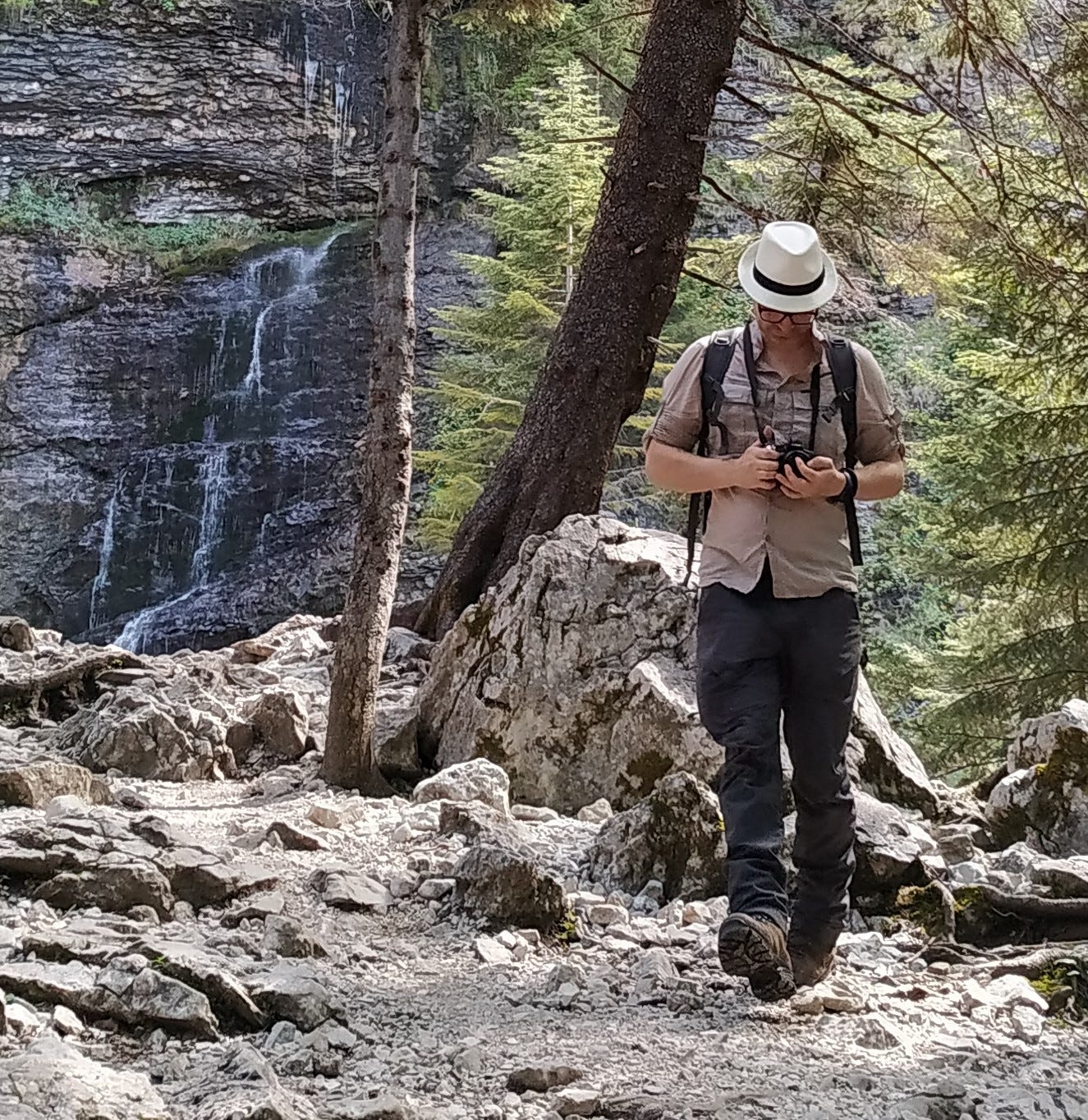
I first connected with Alexander Crow on Substack, drawn in by our shared love of nature, a belief in its quiet but profound healing power, and a mutual reverence for the written word. From our earliest exchanges, I sensed in Alex a kindred spirit—someone who doesn’t just write about the natural world, but lives within it, listens to it, and lets it shape his way of being.
Born in Lincolnshire, England, and raised on the wind-swept Orkney Islands off Scotland’s northern coast, Alex has lived a life deeply rooted in place—and in movement. On the eve of his 40th birthday, he left Scotland and has spent the past eight years immersed in life far from the Anglophone world. Today, he makes his home in a small village where the French Alps begin to climb, alongside his wife Aurélie and their young daughter Ailsa.
Alex is a lifelong student of what we now call bushcraft, with a background in archaeology and a passion for ancestral skills, foraging, wildcrafting, and self-reliance. He’s spent long stretches of time alone in the woods, living from the land, tending to the wild, and letting it tend to him in return. His deep knowledge of nature’s rhythms—along with his handcrafted life and sharp literary instincts—gives his writing a grounded, soulful presence.
In addition to fiction and creative nonfiction, Alex writes for individuals, companies, and travel outlets. But at the core of his work, no matter the form, is a sense of wonder—a desire to understand and honor the world, both human and wild.
This essay is a glimpse into that world and the quiet wisdom Alex carries within it.
Last year, Matthew asked for recommendations for Beyond the Bookshelf and, as soon as I saw one of the requests was for a book originally crafted in a language other than English, then translated, I immediately knew The Summer Book would fit perfectly. I was delighted that he agreed, and that I have this chance to share a few thoughts on what I consider to be a true classic.
If you pay attention, and if you are lucky and wise enough, every so often a book comes along which changes your life. It makes you think in different ways, examine yourself, others, and the world in a new light, and generally adds so much to your very being that you are unsure how you coped before.
I am lucky enough to have encountered several of these books in my life and cannot wait to uncover more. This is the joy of reading, and reading widely. There are so many stories waiting to be discovered by readers, over and over, small miracles of happenstance which, in turn, have the potential to lead to yet others. This cycle of discovery never ceases to amaze me, especially when a book leads the reader (myself, in this case, but perhaps you, too), to a place where those words paint the world in a slightly different light to that in which you experienced it prior to reading.
One such book is, of course, Tove Jansson’s The Summer Book (originally Sommarboken, in Swedish).
I have five younger sisters and this point is key to what I share here. When they were young, and I still lived at home, my mum would read to them (and to me, when I was young). Two books she read to my sisters were Finn Family Moomintroll and Comet in Moominland, by Tove Jansson. And I listened in, later to pick up the books myself for a read and, later still, to read all the Tales in the series.
I cannot remember precisely when I first read The Summer Book, but I do know why. My sister, Lydia, recommended the book a long time ago, a few scant years after the latest edition had been reissued in the UK: in 2003 (the original, in Swedish, was published in 1972, the English translation in 1975).
The translation work, by Thomas Teal, deserves a special mention. Translation is a true art, one which is often overlooked by those reading which, when you think about it, is exactly as it should be. I have read books translated from other languages which jar, where the word choice, or grammar, or structure just does not work in English, and it has ruined the experience, sometimes to the confusion and disappointment of those who recommended it, having read it in the original tongue. The Summer Book is not like that—the prose reads fluidly, it encapsulates exactly what Jansson was sharing (at least I think it does! I have not read the original, as I have no knowledge of Swedish, beyond the toast, skål, but I am certain it cannot be that different) and it is a work of art in its own right.
How The Summer Book is read matters, at least in my personal opinion. The first time, or perhaps the first two or three times I read it, I did so as any other book. Start at the beginning, read, finish it. I didn’t really think about any other way to approach it at that time, I just wanted to read it again, and again. At some point over the last nearly-twenty-years, however, I began to read it differently, waiting until August every year, then reading a chapter (or story) a day. I would read other things whilst doing this, as each story does not take too long to read. What I found was that, as I did this, little moments in each story would surface, perhaps whilst reading but also, equally, during the following day or week. I would be making a cup of tea, or pausing from whatever I was writing at that time, and the story would come back to me.
Sometimes this was an image, sometimes a sentence. At other moments it was a shared experience—I never, ever go searching for anything (and I forage and collect all manner of things, all the time), without thinking about the following quote, for example:
“Gathering is peculiar, because you see nothing but what you’re looking for. If you’re picking raspberries, you only see what’s red, and if you’re looking for bones you see only the white.”
At its simplest, The Summer Book is about two and a half principal human characters. Sophia and her Grandmother are front-and-centre of the tale, and it is around them that all else moves. In the background is Sophia’s father, often mentioned as working, or perhaps setting and tending to the nets, or planting a garden. He has seemingly little agency of his own, other than to be there as, perhaps, a third leg to a stool: the one which sits behind you, mostly invisible but, without that leg, the stool and the story would fall. He is essential, yet absent too.

Others sail around the island, dipping in and out of pages, appearing in this story or that. These others include neighbours, friends, locals, cats, and the summer people (those who only came to the islands to holiday for a short time), and I would argue the cast list also includes the birds, the nature, the small house, the island itself (in the forward to the UK edition by Esther Freud, who visited the real Sophia on the actual island, we learn that it takes her four and a half minutes to walk all around the coast, entirely. This is not a large space, at all, and that remarkable detail adds considerable weight to the tale itself), and the sea in which all the above rests. Rocks and soil become more than simply something beneath the feet, they are described and painted in ways in which they can be felt, in which they can be experienced. Or moss—Jansson makes the reader not just think of moss, but feel it, understand it. It plays the role of a minor character itself, referenced throughout the book as it is. To my mind, this is an echo of her Moomin tales, with similar things and concepts taking a supporting role.
If you know the sea, or have ever lived on an island, so much of this book will be familiar to you—the small things you take for granted, such as the sound of the rocks rolling around in the surf, the sense of a coming storm, still out there beyond the horizon, or the constant scent of the water and coast. When I was eighteen, I left behind my own island upbringing to head to university and, for many months, I felt a hollow within me, something missing, but what, I did not know. I realised, some time later, that it was the sea. To be by or on the waters, then to be taken far inland, beyond the range of a salt-laden breeze, is to lose a part of oneself, and it is a loss I still feel keenly today. In The Summer Book, Tove Jansson makes me taste that brine once more. Her words inspire emotion, sometimes nostalgia, sometimes melancholy, at others a memory of what it means to have been raised an islander, and all that this means. This is not to say the book is at all sentimental—nothing could be further from the truth.
There are truths here in this short volume, many truths, about what it means to be human—whether a human in the spring of a life, or a human in late winter. The way that Jansson subtly shows both the depth of experience we can gather, if only we listen and learn, and the blissful wealth of childhood, the questions, the statements which make a perfect—sometimes startling—form of logic to a small child, statements which, in turn, make those of us much older pause and ponder is, in short, masterful. These are characters we believe in, they feel like real people—based, as they were, on Jansson’s niece Sophia and Jannson’s own mother.
However, this is not a memoir per se, it is something else, a weaving, a layering, a skein of what perhaps actually happened and what perhaps could have happened. To be a writer is to observe, to be a writer is to cannibalise your own experience and the lives of yourself and others, chewing through relationships, nibbling on locations you know, washing it all down with the sheer volume of all that is filtered through our senses and lodges in our brain. To be a writer is to take this and shape it into story, into something of fiction, yet something which the reader believes in. This is a magic of words—and it is a magic at which Tove Jansson excelled.
I have already mentioned the Moomin tales—if, having read them when young, you return to read them as an adult, whether aloud to a child (something I am very much looking forward to with my own daughter, Ailsa, when she is old enough), or for yourself, then you realise just how much is packed into those stories. Not just the wonderful imaginary cast and characters, locations and events, but things which are utterly real. Things which matter, things which tie us all together. Especially once you reach the later books, after Moominland Midwinter, they can arguably be read as philosophy.
It is no wonder Jansson crafted The Summer Book in 1972, after Moominvalley in November —her last Moomin novel—was published in 1970. It is a natural progression and, crucially, she wrote both shortly after the death of her mother, the graphic designer Signe Hammarsten, in 1970.
Throughout this book the absence of Sophia’s mother whispers around the pages, ghostlike, almost entirely unspoken. How the two main characters carry on living in the face of her death says much, and also underpins the background character of the father, how he throws himself into his work, into doing rather than thinking too much—although we, the reader, never know his thoughts on this matter, or any other).
Death and powerful change run through the words, yet never in an overbearing, beat-you-around-the-head manner. Instead, death is portrayed as it is—a constant, something which none of us escape, which is everywhere, if only we look, notice, and acknowledge. Principally western societies have become somewhat divorced from death (a topic I remember receiving much attention when I read Archaeology at university), both the event itself and the aftermath, but in these pages Jansson does a remarkable job of showing how life and death carry on their eternal dance, regardless.
Sophia stands, swims, runs, and clambers through the start of her life, and Grandmother rests near the end, often unbalanced and tired, yet the gulf of years between them, as large as it could seem, is beautifully—and believably—removed. Imparting knowledge in a soft, gentle fashion, sharing a life—when you feel able and the recipient is willing—all the while listening to all those marvellous and constant questions and statements children come up with is, perhaps, one of the greatest joys of being older. For, as Tove Jansson so ably demonstrates in the book, the act of doing so makes us realise that what really matters is being there for one another, being ourselves, real, and, ultimately, human, and all that means—especially our ability to love, even without actually having to resort to saying the words out loud.
I have not yet seen the recent movie of The Summer Book, which I believe will be released in the US in September 2025—it is already out in certain other countries—but I probably will give it a go; Glenn Close as the Grandmother is an intriguing premise, and the cinematography promises much, but I always approach adaptations of works I love with a touch of trepidation, and this is no exception. However, I am absolutely delighted that the movie has been made, as it will undoubtedly bring the book, and its lessons, to new readers—something which, in these times we live in, can only be a very, very good thing. A balm for life, quiet lessons gently told.
For me, The Summer Book is precisely that—a book which I read every summer. It is easy to fit into any reading schedule, short, almost standalone, chapters, twenty-two of them—perfect to read slowly over the season, or to binge and devour swiftly. Normally, I read it in August, a chapter a day, as the hot days feel weary, the crows begin to call that summer is nearly over, and the promise of cooler weather approaches, with lengthening dark nights and the return of the stars. This year, I read it in early summer, and now I have a fresh memory of those words and passages and scenes to accompany me through the hottest of the months.
When I was young, I used to reread The Lord of the Rings every year—as I learned later, this was in a similar fashion to Christopher Lee—but, as I grew older and had less time to read, I stopped, preferring to fit in more new books within a year. I am immensely grateful that over the last decade and a half I have had the meditation which is The Summer Book to fill that gap, in much shorter, more concise, prose. In my view, The Lord of the Rings is certainly a masterpiece, but its wisdom is nowhere near as distilled from that which we sip in The Summer Book.
To find a book which can be reread is a treasure in itself—to find a book which can be reread and experienced in a different manner each time, a true wonder. Every year, I approach my reading with a sense of excitement, every year I try to guess which story shall be the one which makes my emotional side bubble forth, which story shall be the one which tickles my sense of humour, or which shall appeal to the practical, nature-loving, aspect of my character. This is something I very much doubt I shall ever stop doing—to conclude, to me, The Summer Book is a companion to walk alongside, for as long as I am treading this mortal path, in all seasons. And that is deep, deep magic.

Beyond the Bookshelf is a reader-supported publication. Becoming a paid subscriber is the single most impactful way you can support the mission of exploring the connection between life and literature here at Beyond the Bookshelf. An annual subscription is only $12/year.
If you can’t commit to a paid subscription at this time but would still like to support my work, please visit my support page for a list of other ways you can help keep the lights on.
Until next time,


 | A guest post by
|